
The USPTO Trademark Scam Targeting Business Owners the Minute They File
The USPTO Trademark Scam Targeting Business Owners the Minute They File
By Brad Harrigan, Harrigan IP
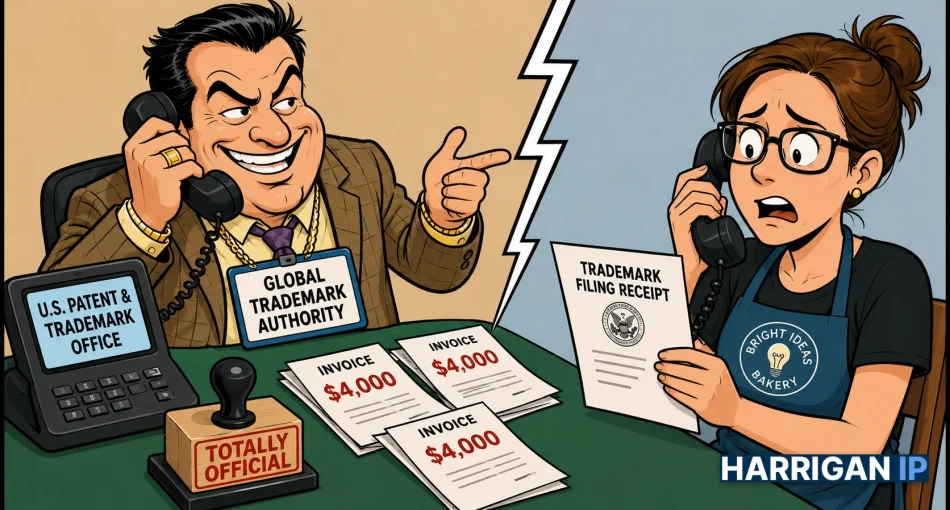
You hit submit on your trademark application, pour yourself a coffee, and the phone rings. The caller ID says it’s the U.S. Patent and Trademark Office. The voice on the line congratulates you, then explains that your filing only covered your “goods” — and for a few thousand dollars more, you can secure “global” protection. That is the USPTO trademark scam, and it is moving fast enough to reach filers within minutes of hitting the button.
A recent warning from a longtime trademark research company describes exactly this play. A client who filed a new intent-to-use application — meaning she filed based on a genuine plan to use the mark, before actually selling anything — got a call almost immediately claiming to be from the “Patent & Trademark” office. Her caller ID displayed the USPTO’s real main phone number.
The caller told her that her $700 filing fee only covered “goods,” and that she needed to pay another $4,000 for “Global Authority” to protect the mark internationally. The next day, she got a follow-up email from a domain that had been registered just two days earlier, dressed up to look like official USPTO correspondence and asking for a “verification call” to confirm her application details.
None of That Is How the USPTO Works
Let’s be blunt about the two biggest lies in that pitch. First, the USPTO does not call you demanding more money after you file. When the office has something substantive to tell you — a problem with your application, a refusal, a request for clarification — it does that in writing, through a formal document called an Office Action posted to your official case record. If you get one of those, that is a normal part of the process, and it’s worth understanding how the filing process actually flows so nothing catches you off guard.
Second, there is no such thing as a “global trademark.” I wish there were — it would make my job easier and my clients’ lives cheaper. But trademark protection is jurisdiction-specific. A U.S. registration protects you in the United States. Protecting a brand in other countries means filing in those countries or through specific international systems, and it is a deliberate decision you make, not a $4,000 upsell a stranger springs on you over the phone.
So when someone calls minutes after you file, waves around a fake “global” registration, and demands immediate payment, you already have everything you need to know it’s fake. Hang up.
The Warning Signs, in Plain English
The scam relies on a handful of recurring tricks, and once you know them they get easy to spot.
Spoofed caller ID. Scammers can make your phone display any number they want — including the USPTO’s published number. Caller ID is not proof of who is calling. Treat it as decoration, not evidence.
Urgency and add-on fees. Any inbound demand to “expedite,” “protect globally,” or “verify” your application by paying right now is not part of standard USPTO procedure. Real government fees are tied to specific filings you choose to make, not to a ticking clock a caller invents.
Look-alike domains. Newly registered domains built to resemble government addresses are a favorite tool. The USPTO’s only official website ends in .gov. If an email is pushing you toward anything else, it’s not them.
Unsolicited “verification” calls. The office communicates status and issues in writing, through your official case record — not with phone calls fishing for personal or payment information.
The same warning also notes darker versions of this fraud: scammers listing their own email addresses on official filings, misusing third-party verification services, and in some cases forging applicant signatures. That last one matters. Submitting a trademark application with a forged signature is a federal offense, and the USPTO can terminate any application found to have been filed that way. If you’re not sure who actually submitted something in your name, that’s a reason to look closely at your own record.
What to Do the Next Time Your Phone Rings
Here’s the routine I’d give any client. Verify directly. Check your application status only through the USPTO’s official Trademark Status and Document Retrieval (TSDR) system at uspto.gov. That record is the source of truth for what’s really happening with your filing.
Hang up and call back independently. Never give payment information to someone who called you. If you have a genuine question, look up the USPTO’s number yourself and dial it — don’t trust the number that called in.
Treat any phone call about a pending application as a red flag. The office corresponds about the real stuff in writing. A voice on the phone asking for money is the opposite of official.
Report it. Suspected scams can be reported to the USPTO and to the Federal Communications Commission, which publishes guidance on caller ID spoofing at fcc.gov.
What This Means for Your Business
The reason this scam works is that it hits you at your most anxious moment. You just spent money and effort protecting a brand you care about, and a caller shows up sounding official and warning that it isn’t safe yet. That fear is the product they’re selling.
Don’t let it make you gun-shy about protecting your brand. Filing a trademark is a smart investment in the long-term value of your business, and knowing what the real process looks like is what makes a fake one obvious. If you understand that legitimate USPTO contact comes in writing through your case record, a slick phone call demanding $4,000 stops being scary and starts being almost funny.
Working with someone who handles this every day helps too. Part of what you’re paying for when you hire an attorney or a trusted provider is a person who can tell you, in ten seconds, whether a message is real. A quick understanding of what a trademark actually is and what it really costs goes a long way toward inoculating you against this stuff.
If you’ve recently filed and got a call or email that made your stomach drop, don’t wire anyone anything. Reach out to Harrigan IP and we’ll pull up your actual case record together and tell you whether it’s legitimate. If you’re ready to file the right way, our flat-fee trademark registration service walks you through the real process from the start — and our trademark monitoring keeps an eye on your brand so you’re never guessing about what’s real. Want to understand the ongoing side of protection first? Start with what a trademark monitoring service does.
Get startedQuestions? Talk to Harrigan IP
Contct Us
Contact Us Today
"*" indicates required fields
Location
Harrigan IP
8117 Oak Street, Suite 203
New Orleans, LA 70118

Phone
© Copyright 2026 Harrigan IP. All rights reserved.