
$150 Million in Fake Labubus and Knicks Gear Seized: What It Means for Your Brand
$150 Million in Fake Labubus and Knicks Gear Seized: What It Means for Your Brand
By Brad Harrigan, Harrigan IP
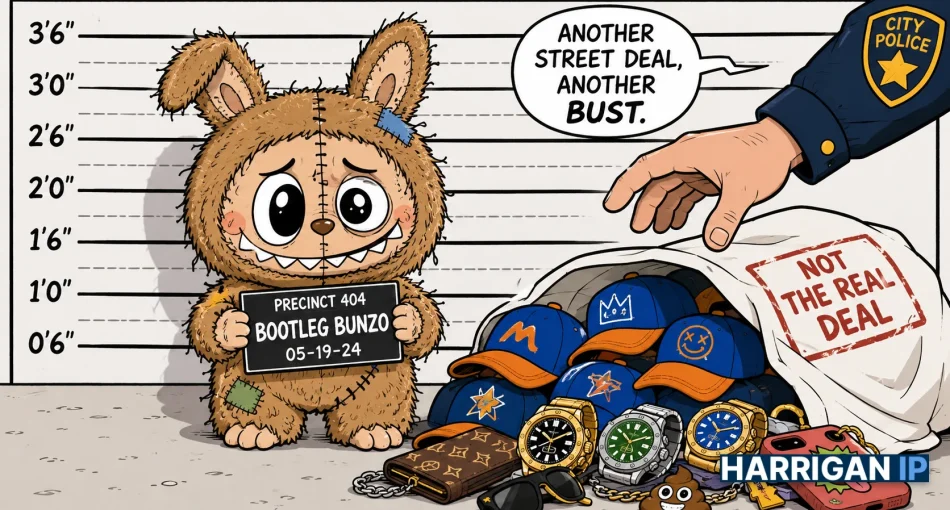
New York police just hauled in roughly $150 million worth of fake merchandise in a single raid through Lower Manhattan’s Chinatown. According to amNewYork, the NYPD arrested 17 people on trademark counterfeiting charges while sweeping 12 storefronts on Thursday. The confiscated haul reads like a knockoff department store: fragrances, fake Rolex and Piguet watches, luxury sunglasses, bootleg Knicks apparel, jewelry, electronics, and even fake versions of the viral Labubu plush figurines.
If you’re a small business owner, this might sound like a big-brand problem. It isn’t. The legal machinery that lets law enforcement seize counterfeit goods runs on something every brand owner can have: a registered trademark. That’s the real story here, and it’s worth understanding before someone starts selling a knockoff version of your product.
What “trademark counterfeiting” actually means
A counterfeit is a fake product that copies a registered trademark to fool buyers into thinking it’s the real thing. It’s the most aggressive form of trademark infringement — not a competitor with a confusingly similar name, but a deliberate copy of your brand stamped onto goods you never made.
The 17 people arrested were charged with trademark counterfeiting, a crime under New York law. That criminal charge exists because each of those fake watches, caps, and plush toys carried a brand name that someone else owns and registered. The registration is what turns “selling a knockoff” into a prosecutable offense.
The raids weren’t random, either. Police told amNewYork the sweep was driven by a fourfold spike in 311 complaints about illegal vending and panhandling in the area since 2025, plus pressure from local elected officials. Since May 20, the city has confiscated an estimated $100 million in fake luxury items, and Thursday’s warrants pushed the year’s total past an estimated $250 million in knockoff goods.
Why counterfeiters target recognizable brands — including smaller ones
Counterfeiters chase recognition, not company size. A bootlegger copies whatever a customer will reach for: a viral toy like Labubu, a hometown team’s apparel like the Knicks, a watch brand, a fragrance. The common thread is that buyers already know and want the name.
Plenty of small and mid-sized brands hit that same level of recognition in their niche. A regional snack brand, a popular boutique label, a hot direct-to-consumer product — once your name moves units, someone will eventually try to ride your reputation. The fact that you’re not a global luxury house doesn’t protect you. If anything, smaller brands are softer targets because they’re less likely to have registrations and enforcement plans in place.
This is why choosing a strong, distinctive trademark matters from day one. A distinctive name is easier to register, easier to protect, and easier for both customers and law enforcement to recognize as yours.
The registration is the legal foundation
Here’s the part that connects a New York street raid to your business. A federal trademark registration is the document that gives you the strongest rights to stop counterfeits and pursue damages. Without it, your options shrink fast.
A registration on the Principal Register gives you nationwide rights to your mark, a public record that puts the world on notice, and the legal standing to work with law enforcement, customs, and the courts. It’s the difference between saying “that’s my brand” and being able to prove it with a government-issued certificate. If you’re fuzzy on what that register is, here’s a plain-English breakdown of the Principal versus Supplemental Register.
Common-law rights — the limited protection you get just by using a name in commerce — exist, but they’re weaker, geographically narrow, and far harder to enforce against counterfeiters. When fakes are flooding sidewalks and storefronts, you want the registered version of your rights, not the hope-and-pray version.
What this means for your business
Three practical takeaways come out of this bust. First, register before you need to enforce. Enforcement against counterfeits assumes you already hold a registration — you can’t go grab one mid-crisis and have it work retroactively. The time to file is when your brand is gaining traction, not after the fakes show up.
Second, registration is also your ticket to other defenses. A federal registration lets you record your mark with U.S. Customs and Border Protection so officers can seize counterfeit imports at the border, and it strengthens your hand on online marketplaces. If you sell on Amazon, a registration is the gateway to Amazon Brand Registry and its takedown tools.
Third, you have to actually watch for fakes. Law enforcement responded here because of a flood of complaints, but no one is going to police your specific brand for you. Trademark monitoring is how you catch knockoffs and copycat filings early, while they’re still cheap and easy to shut down. If you want the bigger picture on what to do when someone copies you, we covered that in what happens if someone infringes your trademark.
The brands in this raid had one thing the counterfeiters couldn’t fake: registered rights that turned a sidewalk full of knockoffs into a $150 million crime scene. Your brand can have that same foundation. It just has to be filed first.
Protect your brand before the knockoffs show up. Contact Harrigan IP to talk through your options, or get started with our flat-fee Comprehensive trademark package for a registration built to be enforced. Already registered? Add trademark monitoring so you’re the first to know when someone tries to copy you.
Get startedQuestions? Talk to Harrigan IP
Contct Us
Contact Us Today
"*" indicates required fields
Location
Harrigan IP
8117 Oak Street, Suite 203
New Orleans, LA 70118

Phone
© Copyright 2026 Harrigan IP. All rights reserved.