
Rise Brewing v. PepsiCo: Who Decides How Strong Your Trademark Is?
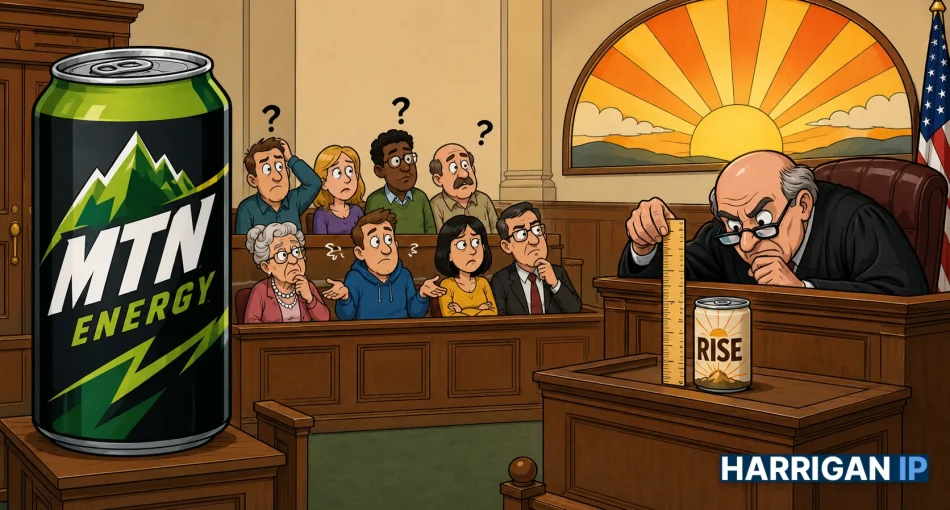
Rise Brewing v. PepsiCo: Who Decides How Strong Your Trademark Is?
By Brad Harrigan, Harrigan IP
The Supreme Court just agreed to hear a fight over a soda name, and the outcome could change how every small brand proves it owns its name in court. On June 29, the justices took up canned-coffee maker Rise Brewing’s appeal against PepsiCo over Pepsi’s morning energy drink, “Mtn Dew Rise.” The narrow legal question hiding inside it is about trademark strength — and whether a judge or a jury gets to decide it.
That sounds like inside-baseball. It isn’t. If you own a registered mark, the answer determines how much real-world protection that registration buys you when a much bigger company shows up using something close to your name.
How a Coffee Brand Ended Up Fighting a Soda Giant
Pepsi launched Mtn Dew Rise, a fruit-flavored energy drink aimed at morning drinkers, in 2021. Stamford, Connecticut-based Rise Brewing — the canned-coffee company — sued later that year, alleging trademark infringement and customer confusion with its coffee brand.
Rise asked for money damages and a court order blocking Pepsi from using the “Rise” name. It argued that Pepsi, which also distributes Starbucks coffee drinks, was trying to “destroy a leading competitor” by flooding the market with a similarly named product.
Rise won the first round. Manhattan-based U.S. District Judge Lorna Schofield temporarily blocked Pepsi from using “Mtn Dew Rise,” citing evidence that it posed an “existential threat” to Rise’s business. Pepsi renamed the drink “Mtn Dew Energy,” then discontinued it altogether in 2024.
But the win didn’t hold. The 2nd U.S. Circuit Court of Appeals overturned Schofield’s order in 2022. Pepsi then convinced the same judge to throw out the case entirely in 2023, and the 2nd Circuit affirmed that dismissal in 2024.
Why the Judge Said “Rise” Was a Weak Mark
Here’s the part that matters for your business. The judge concluded that Rise’s trademark rights were weak because of the “strong logical associations between ‘Rise’ and coffee.” She agreed with the appeals court that the differences in the two drinks’ branding were “far more notable than the similarities.”
To translate: a court was weighing the trademark strength of the word “Rise” for coffee. In trademark law, strength comes in two flavors. There’s commercial strength — how well-known the brand actually is in the market. And there’s conceptual strength — how distinctive the word itself is, before any advertising. A made-up word like KODAK is conceptually strong. A word that practically describes the product, or strongly suggests it, is conceptually weak.
“Rise” for a morning coffee drink leans toward that weak end — it suggests waking up, getting going, the thing coffee is for. Weak marks get a narrower zone of protection, which makes it harder to stop a competitor from using something similar. If you’ve ever wondered why we push clients toward distinctive names, this is exactly why. A name that describes what you sell is easy to launch and hard to defend.
The Real Issue at the Supreme Court
Rise didn’t appeal because it disagrees about distinctiveness in the abstract. It appealed over who decides. Rise told the Supreme Court that the strength of its trademarks was a factual question that should not have been decided by a judge — and that other federal appeals courts have left that question to juries.
Pepsi called the case a “run-of-the-mill trademark dispute,” argued there’s no real split among the appeals courts, and said the issue “lacks sufficient importance” to warrant the Supreme Court’s attention. The Trump administration urged the Court not to hear the appeal. The justices took it anyway. They’re expected to hear argument during the term that begins in October.
So the question on the table is procedural but powerful: is trademark strength a fact for a jury, or a legal call a judge can make on the papers and dismiss the case before trial? Whichever way the Court lands, it changes the leverage in infringement disputes across the country.
What This Means for Your Business
If the Court says strength is generally a jury question, more trademark cases survive early dismissal and reach a jury. That helps smaller plaintiffs who can’t afford to be knocked out at summary judgment, and it raises the stakes for anyone defending a claim. If the Court says judges can decide it as a matter of law, weak-mark cases get tossed faster — cheaper for defendants, harder for owners of borderline names.
Either way, the lesson lands in the same place: the strength of your mark is the whole ballgame. A distinctive, non-descriptive name gives you a wider zone of protection and a stronger hand whether the decision-maker is a judge or twelve jurors. A descriptive one leaves you arguing about “logical associations” while a competitor walks off with your customers.
This is why the work happens before you file, not after the lawsuit. A real clearance search and an honest read on distinctiveness tell you whether your name is built to defend. Choosing a stronger mark on the front end is far cheaper than learning your mark was “weak” from a federal judge. And if you’re stuck with a descriptive name, there are ways to build commercial strength over time — but you want a plan, not a surprise.
It also underscores why watching for conflicting filings matters. Rise found out about Mtn Dew Rise the hard way, after a product was already on shelves. Catching a problem at the application stage gives you cheaper, earlier options than litigating against a giant after launch.
Watch This One
Most trademark fights never get near the Supreme Court. This one will, and the ruling could quietly reshape how every registered mark gets defended. We’ll be following it through the next term. For now, the takeaway for small brands hasn’t changed: pick a name worth protecting, and protect it early.
Worried your name lands on the weak end of the spectrum — or that someone bigger is creeping toward it? Reach out to Harrigan IP and we’ll talk it through. If you’re ready to file, our flat-fee Comprehensive package includes the clearance work that flags strength problems before they become courtroom problems. And if you want to keep an eye out for the next Mtn Dew Rise aimed at your brand, here’s how trademark monitoring works.
Get startedQuestions? Talk to Harrigan IP
Contct Us
Contact Us Today
"*" indicates required fields
Location
Harrigan IP
8117 Oak Street, Suite 203
New Orleans, LA 70118

Phone
© Copyright 2026 Harrigan IP. All rights reserved.