
The Fake USPTO “Verification Appointment” Trademark Scam, Explained
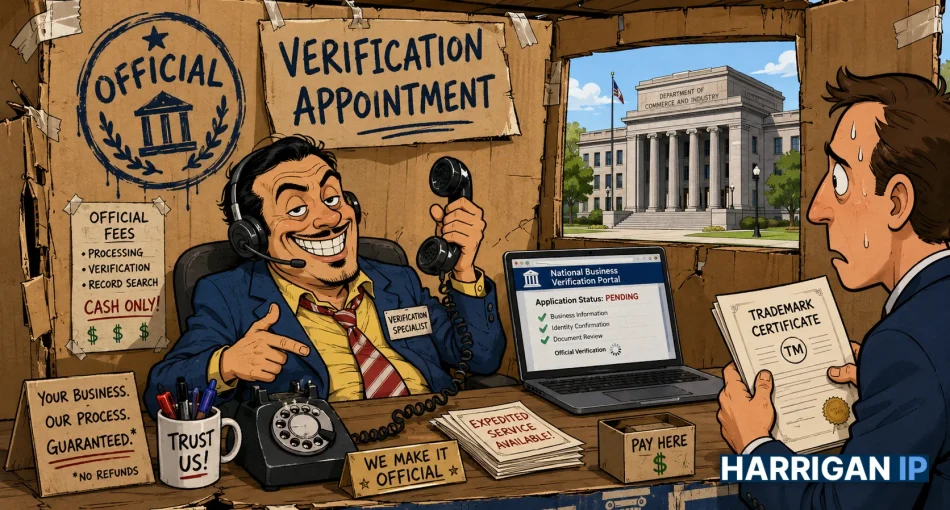
The Fake USPTO “Verification Appointment” Trademark Scam, Explained
By Brad Harrigan, Harrigan IP
If you have ever filed a trademark application, your name, address, and email are sitting in a free, public government database for anyone on earth to read. Scammers know this, and they use it against you. One of the newer trademark scam variations arrives as an urgent email demanding you attend a “verification appointment” by phone with a named USPTO examining attorney before your application can move forward.
It is fake. The United States Patent and Trademark Office does not schedule phone appointments to “verify” your application, and no real examining attorney will cold-call you to collect your EIN and business details over the phone. Below is what this trademark scam looks like, why it is convincing, and exactly what to do if one lands in your inbox.
What the scam email actually says
These messages are built to look like routine government correspondence. They pull real data straight off your published application, drop in an official-sounding office name, and invent a deadline to make you panic. Here is a representative example of the language being used, with the identifying details swapped out for placeholders:
From: USPTO GOV <[email protected]>
Sent: [Date]
To: [Applicant Email]
Subject: ACTION REQUIRED: VERIFICATION APPOINTMENT — [Serial Number]Dear Applicant,
Your trademark application requires a verification appointment before it can proceed to the next stage of processing. This appointment is intended to confirm the owner details, business information, goods and services, and other application-related information.
The trademark details are as follows: Mark Name: [Mark], Serial Number: [Serial Number], Legal Entity Type: [Entity Type] Citizenship: [Citizenship], Owner Name: [Owner], Address: [Owner Address], and Assigned Office: [Law Office].
Your scheduled verification appointment is with Examining Attorney [Name]. Please call [Phone Number] on [Date], at [Time]. Your appointment number is #[Number], and the assigned office is [Law Office].
During the call, please be prepared to confirm your owner name, serial number, business address, duration of business use, goods and services, position in the company, business description, and EIN if available.
Please make sure to call at the scheduled appointment time. If you are unable to attend, kindly reply with your availability as soon as possible so the appointment can be reviewed. Missing the appointment may delay the verification process.
Please reply to this email to confirm that you have received the appointment details.
Notice how much of that is accurate. The mark, the serial number, the owner name, the address, the assigned law office number, even a plausible examining attorney name. All of it is easy to lift from the public record. Accuracy is the trick, not proof of legitimacy.
The tells that give it away
Start with the sender. The email above comes from usptolawoffice.live. That is not a government domain. As the USPTO itself explains on its page on recognizing common trademark scams, authentic USPTO emails sent to you end in @uspto.gov, and its official websites live at USPTO.gov or my.USPTO.gov. Anything ending in .live, .info, .org, or a lookalike variation is a red flag no matter how official the body of the message reads.
Then look at what they are asking for. A real examiner communicates about your application through an official office action posted to your file, and you respond in writing through the USPTO’s electronic system. They do not book a phone “appointment” and ask you to recite your EIN, your position in the company, and your business banking-adjacent details out loud to a stranger who called you.
The manufactured urgency is the third tell. “Action required.” “Missing the appointment may delay the verification process.” Scammers lean on fear of losing your trademark or your filing because a scared person acts before thinking. The USPTO gives you real deadlines in writing, with real response windows, and losing a mark never hinges on returning a phone call within hours.
Why these emails are so convincing
Every trademark application on file is public. The moment you file, your mark, serial number, owner name, mailing address, correspondence email, and the assigned law office become searchable by anyone. Scammers scrape that data and mail-merge it into templates, which is why the notice knows your exact serial number and address.
The USPTO also warns about a nastier layer to this. Some operators secretly sign victims up for legitimate USPTO alert emails through the agency’s Subscription Center, then call and reference those real alerts to sound credible. When a caller can name your mark and point to an email you actually received from the USPTO, the pressure feels real.
This particular “verification appointment” flavor is a phishing operation. The goal of collecting your EIN, your role, and your personal details is identity and account theft, not trademark processing. In related schemes the payoff is different but equally damaging: some scammers file unauthorized requests to change the correspondence email on your registration so they can hijack your Amazon Brand Registry verification and claim your brand on e-commerce platforms.
What to do if you get one
Do not call the number. Do not reply. Do not confirm anything, and absolutely do not read out your EIN or personal information. Replying only confirms to the sender that your inbox is live and worth targeting again.
Report it. Forward the email to [email protected], the address the USPTO maintains specifically for these solicitations and spoofed messages. Reporting helps the agency track the operation and warn others.
Verify through the real record. You can look up any application yourself in the USPTO’s public database and see the true status and correspondence history. If an official communication is genuinely pending on your file, it will be there in writing. And if you filed through an attorney, the correspondence goes to the attorney, so any “appointment” email sent straight to you is doubly suspicious.
This is a big part of why working with counsel matters. When your attorney is the correspondent of record, real USPTO communications route through the firm, which knows what a legitimate office action looks like and what the agency will never ask for by phone. A scam email that lands in your personal inbox becomes obvious the second you forward it to someone who handles these every day.
The broader scam landscape
The phony appointment is one entry in a long catalog. The most common trademark scam is still the deceptive paper notice, an official-looking letter offering “registration,” “monitoring,” or “renewal” services you either do not need or already have, often with names that mix in words like “United States,” “Trademark,” “Office,” or “Agency” to sound governmental. The fine print usually admits, quietly, that the sender is not a federal agency.
Others target maintenance deadlines with fake renewal invoices, because a registered mark needs periodic filings to stay alive and a well-timed fake bill catches people off guard. If you want to keep your registration healthy without getting fleeced, understand the real trademark renewal timeline and who your actual correspondent is.
The USPTO also flags fraud aimed at the register itself, like doctored specimens made on “specimen farm” sites, fake domicile addresses used to dodge the U.S.-attorney requirement, and applications that over-claim goods and services the owner never sells. Those hurt everyone by clogging the register and making it harder for honest brands to get through, which is one more reason to file cleanly and truthfully. If you are still learning the ropes, our guide on how to file a trademark walks through the legitimate process end to end.
Here is the rule of thumb that cuts through all of it. The government does not ask you to pay a mysterious fee by phone, does not schedule verification calls, and does not communicate through domains that are not uspto.gov. When a message pressures you to act right now or lose everything, slow down. Urgency is the scammer’s favorite tool.
If a suspicious “USPTO” email, letter, or phone call has you second-guessing your application, don’t guess. Contact Harrigan IP and I’ll tell you in plain English whether it’s real. For owners who want to keep watch over their brand and catch problems early, our trademark monitoring service keeps eyes on your mark, and if you’re ready to file the right way with real counsel handling your correspondence, start with our flat-fee trademark registration. You can also read more on what a monitoring service actually does to protect your brand.
Get startedQuestions? Talk to Harrigan IP
Contct Us
Contact Us Today
"*" indicates required fields
Location
Harrigan IP
8117 Oak Street, Suite 203
New Orleans, LA 70118

Phone
© Copyright 2026 Harrigan IP. All rights reserved.