
Here’s Why MLB Struck Out on Registering ‘Play Ball’ as a Trademark
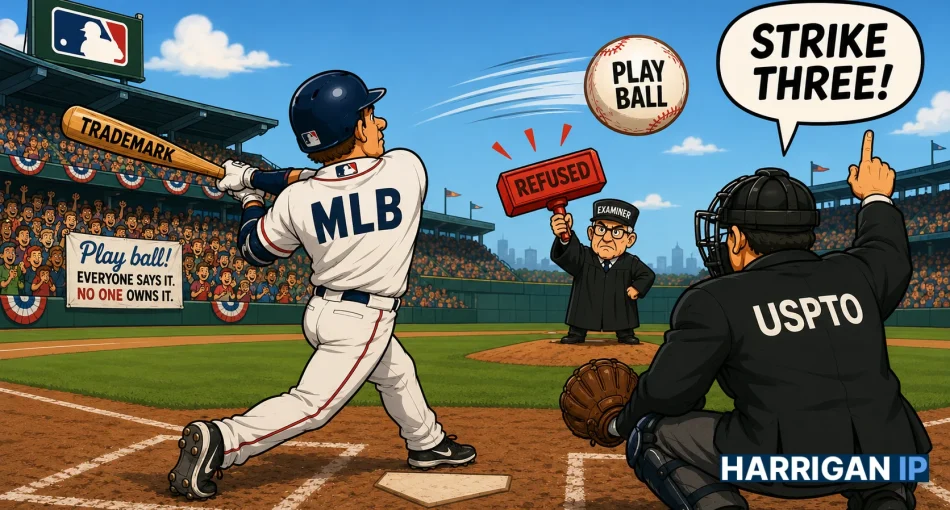
Here’s Why MLB Struck Out on Registering ‘Play Ball’ as a Trademark
By Brad Harrigan, Harrigan IP
Major League Baseball tried to lock up two of the most familiar words in American sports, and the U.S. Patent and Trademark Office threw the flag. In a final Office action issued June 27, 2026, an examining attorney refused MLB’s application to register PLAY BALL, ruling that the phrase does not work as a trademark at all.
The reason is one small business owners run into constantly: some words are just too common to own. The Play Ball trademark refusal is a clean, high-profile example of a doctrine that trips up applicants at every level — from a solo Etsy seller to a billion-dollar sports league.
What MLB Was Trying to Register
The application (Serial No. 97227010) was filed by Major League Baseball Properties, Inc. for the mark PLAY BALL. According to the record, the phrase was being used on clothing — shirts and similar goods. That detail matters, because how a phrase is used shapes whether consumers see it as a brand or as, well, just a phrase on a shirt.
An Office action is the USPTO’s official letter explaining why an application can’t sail through. When it’s marked “final,” it means the examiner has already heard the applicant’s arguments once and isn’t budging. MLB now has three months to either appeal to the Trademark Trial and Appeal Board or file a request for reconsideration.
The Legal Problem: ‘Failure to Function’
The refusal rests on Sections 1, 2, and 45 of the Trademark Act for what the USPTO calls “failure to function.” In plain English: a trademark has to point to a single source. When you see the swoosh, you think Nike. That’s the whole job of a mark — to tell you who made the thing.
The examiner’s finding was that PLAY BALL doesn’t do that. The Office action describes it as “a commonplace term, message, or expression widely used by a variety of sources that merely conveys an ordinary, familiar, well-recognized concept or sentiment.” It’s an umpire’s call to start a game, and it’s also everyday slang for “let’s cooperate” or “let’s get started.”
The USPTO put it bluntly in the guiding case law it cited: “The more commonly a term or expression is used, the less likely that the public will use it to identify only one source.” Everyone knows the phrase. Nobody hears it and thinks of one company.
The Evidence Sank the Application
Here’s the part that should get every apparel seller’s attention. The examiner attached screenshots from multiple online stores — a whole list of them — selling shirts that already say “Play Ball” or “Let’s Play Ball.” Different brands, different shops, same phrase splashed across the front.
That’s the death blow for a slogan mark. When a phrase is already plastered on merchandise sold by a dozen unrelated sellers, the USPTO’s position is that shoppers read it as a decorative message, not as a badge telling them who the maker is. Lawyers call this “ornamental” use, and it’s the same reason you generally can’t register a common saying just because you printed it big on a tee. We cover the underlying trap in our piece on whether you can trademark a viral phrase.
The examiner leaned on two well-known precedents to make the point: a case refusing DRIVE SAFELY for cars as an “everyday, commonplace safety admonition,” and another refusing INVESTING IN AMERICAN JOBS as a commonly-used informational message. PLAY BALL landed in the same bucket.
Why MLB Can’t Just Argue Its Way Out
Normally, when a mark is refused for being weak, an applicant has escape hatches. You can try to move to the Supplemental Register, or you can claim “acquired distinctiveness” — basically arguing that after years of use, the public now does associate the phrase with you.
Not here. The Office action closes both doors. It states that this kind of refusal can’t be overcome by amending to the Supplemental Register, by claiming acquired distinctiveness under Section 2(f), or even by swapping in a different specimen. A failure-to-function refusal is a wall, not a hurdle. If the phrase itself doesn’t operate as a brand, no amount of sales history fixes that particular defect.
That’s a critical distinction. A merely descriptive mark can sometimes earn its way onto the register over time. A commonplace informational phrase generally cannot. This is why choosing a strong trademark from day one saves you the heartbreak — and the filing fees.
What This Means If You Sell Merch
Small apparel brands love a punchy slogan. The instinct makes sense — a good phrase sells shirts. But selling shirts and owning a trademark are two different games, and the PLAY BALL refusal shows exactly where they split.
If the phrase is used across your industry, and if you’re printing it large and central on the product like a design element, the USPTO is likely to see decoration rather than a source identifier. The fix is usually to build a mark around a distinctive brand name and treat the slogan as, at most, a secondary tagline — or to pick a phrase that isn’t already everyone’s property. A proper clearance search before you file will flag a crowded field like this one fast.
The irony is worth savoring: MLB owns a mountain of valuable trademarks, but even it can’t fence off two words the whole country has been shouting since before the league existed. Some phrases belong to everybody, and that’s the point.
One housekeeping note before treating any of this as gospel: an applicant can still respond, appeal, or let the application go abandoned, so the current status can change. Confirm the mark, owner, goods, action type, and live status against the USPTO’s TSDR database and the coverage at WCVB before relying on it.
Thinking about protecting a name or slogan of your own? Don’t file blind into a crowded field. Get in touch with Harrigan IP and we’ll tell you straight whether your mark is worth filing. When you’re ready, our Comprehensive package includes the clearance work that catches these problems before the USPTO does — and if a refusal does land, our Office action response service is built for exactly that fight.
Get startedQuestions? Talk to Harrigan IP
Contct Us
Contact Us Today
"*" indicates required fields
Location
Harrigan IP
8117 Oak Street, Suite 203
New Orleans, LA 70118

Phone
© Copyright 2026 Harrigan IP. All rights reserved.