
Why the USPTO Hit the Brakes on Anthropic’s Logo Trademark
Why the USPTO Hit the Brakes on Anthropic’s Logo Trademark
By Brad Harrigan, Harrigan IP
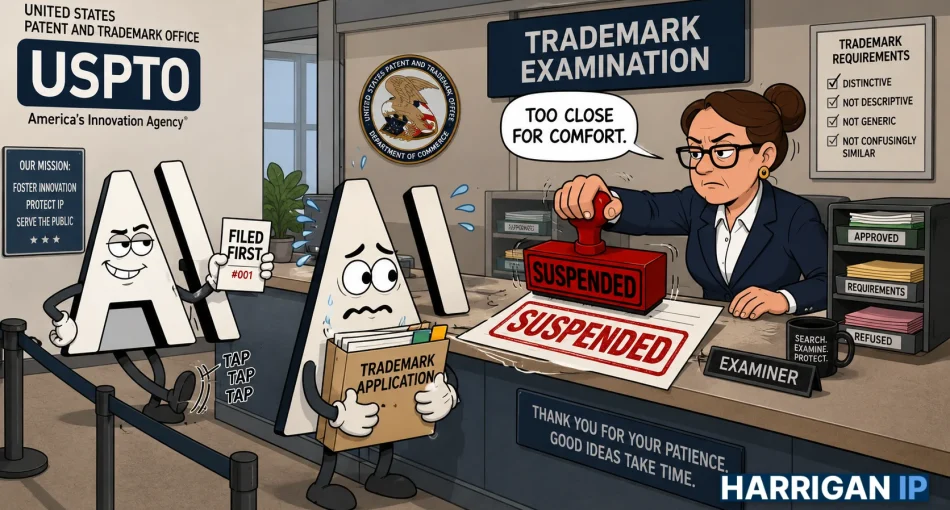
One of the most talked-about names in artificial intelligence just ran into a problem that has nothing to do with chatbots and everything to do with timing. The USPTO suspended Anthropic’s application to register its stylized ‘A’ logo, and the reason is a cautionary tale every brand owner should read. The Anthropic logo trademark got stuck behind somebody else’s earlier-filed application for a remarkably similar design.
This is the kind of traffic jam that happens at the trademark office more often than people realize. A company builds a brand, files to protect it, and discovers that someone else got to the counter first with a mark that looks a lot like theirs. Let’s walk through what the public USPTO and TTAB records actually show.
What the Records Show
On November 6, 2025, Anthropic, PBC filed four applications to register a stylized letter ‘A’ — described in its filings as a stylized letter A next to a slanted line displayed to the right of the letter. The four applications cover different categories of goods and services: downloadable AI software (Class 9), public policy and business consulting (Class 35), educational and publication services (Class 41), and AI software-as-a-service and research (Class 42).
On June 9, 2026, a USPTO examining attorney issued a suspension notice on at least one of those applications, Serial No. 99483730. A suspension notice is the trademark office hitting pause. It is not a refusal — the application is alive — but examination stops until something else gets resolved.
The notice spells out the reason. There is an earlier-filed application, Serial No. 99080304, that the USPTO believes could conflict with Anthropic’s mark. If that earlier application registers, the office may refuse Anthropic’s mark under Section 2(d) of the Lanham Act because of a likelihood of confusion. Until the earlier application registers or abandons, Anthropic’s application waits in line.
Who Got There First
That earlier-filed ‘A’ application belongs to Abnormal Security Corporation, a cybersecurity company. Abnormal filed its application on March 12, 2025 — several months before Anthropic filed its four applications in November 2025. In trademark law, filing dates matter enormously, and Abnormal’s earlier date is exactly why the examiner pressed pause on Anthropic’s filing.
Abnormal’s mark is also a stylized ‘A.’ Its application describes it as a stylized letter ‘A’ without the horizontal bar, appearing as an inverted V, with an additional line parallel to its rightmost slanting side. If that sounds familiar, that is the whole problem. Two AI-adjacent tech companies, both reaching for a minimalist ‘A’ monogram with a slanted accent line. Branding minds apparently think alike.
Abnormal’s application was published for opposition on September 23, 2025 — meaning the USPTO examined it, approved it, and opened a window for the public to object before it registers. That window is where this story gets interesting.
Anthropic Punched Back
Rather than sit and wait, Anthropic opened a second front. On November 21, 2025, Anthropic filed a Notice of Opposition against Abnormal’s application, kicking off Opposition No. 91303262 before the Trademark Trial and Appeal Board (the TTAB, the in-house court that handles registration disputes).
Anthropic’s opposition argues priority and likelihood of confusion under Section 2(d). In plain terms, Anthropic claims it used its ‘A’ mark first — pointing to first-use dates as early as May 2021 — and that Abnormal’s later-filed mark is confusingly similar. Anthropic’s filing argues that the marks both feature a stylized ‘A’ with a parallel line on the right slanting side, and that Abnormal’s deletion of the crossbar does not create a meaningfully different commercial impression.
These are allegations. The TTAB will decide whether Anthropic actually has priority and whether confusion is likely. Abnormal will get its say. The point for our purposes is the gridlock: the suspension notice itself flags this opposition proceeding as a reason Anthropic’s own applications are frozen, because the outcome could directly affect whether Anthropic’s mark can register.
The Whole Thing Is a Standoff
Step back and look at the shape of it. Abnormal filed first, which froze Anthropic’s later applications. Anthropic responded by opposing Abnormal’s application, which means Abnormal’s mark cannot register until that fight ends. Nobody’s ‘A’ is registering anytime soon. Two companies are locked in a staring contest over a single letter of the alphabet rendered with a diagonal line.
This is what happens when brand equity gets built before the trademark picture is fully cleared. By the time a dispute like this surfaces, both sides have logos on websites, products, and marketing. Walking away from a logo you have spent years promoting is expensive and painful — which is precisely why these fights drag on.
What This Means for Your Business
You do not need to be a multibillion-dollar AI lab to land in this exact situation. A frozen application over a lookalike logo is a small-business problem dressed up in a big-company headline.
First, clear your mark before you fall in love with it. A real clearance search looks for confusingly similar marks — including design marks and pending applications, not just exact word matches — so you learn about the other ‘A’ before you have printed ten thousand business cards. For why this matters so much, see our piece on searching before you file.
Second, understand that logos can be weaker than you think when they boil down to a single stylized letter. The fewer distinctive elements a design has, the easier it is for two companies to land in overlapping territory. A simple monogram looks clean and modern — and leaves less room to argue your logo is meaningfully different from the next one.
Third, filing date is leverage. Earlier filings can freeze later ones, and earlier actual use can support a priority claim in an opposition. The race to the trademark office is real, and the company that moves deliberately and early usually has the stronger hand. Our overview of choosing a strong trademark explains how to pick something defensible from the start.
Finally, this is why monitoring matters. Anthropic caught Abnormal’s application during the opposition window and acted in time. If you are not watching new filings, a confusingly similar mark can slide through to registration while you are busy running your business.
If you are building a brand and want to know whether the road ahead is clear — or whether someone is already parked in your lane — get in touch with Harrigan IP. Our Comprehensive registration package pairs a full clearance search with your filing so you are not finding out about the other ‘A’ after the fact, and our trademark monitoring service keeps watch for lookalikes the moment they hit the register. Catching the problem early is always cheaper than untangling a standoff later.
Contct Us
Contact Us Today
"*" indicates required fields
Location
Harrigan IP
8117 Oak Street, Suite 203
New Orleans, LA 70118

Phone
© Copyright 2026 Harrigan IP. All rights reserved.