
Levi’s Is Suing Over a Pocket Tab — What Small Apparel Brands Must Know About Trade Dress
Levi’s Is Suing Over a Pocket Tab — What Small Apparel Brands Must Know About Trade Dress
By Brad Harrigan, Harrigan IP
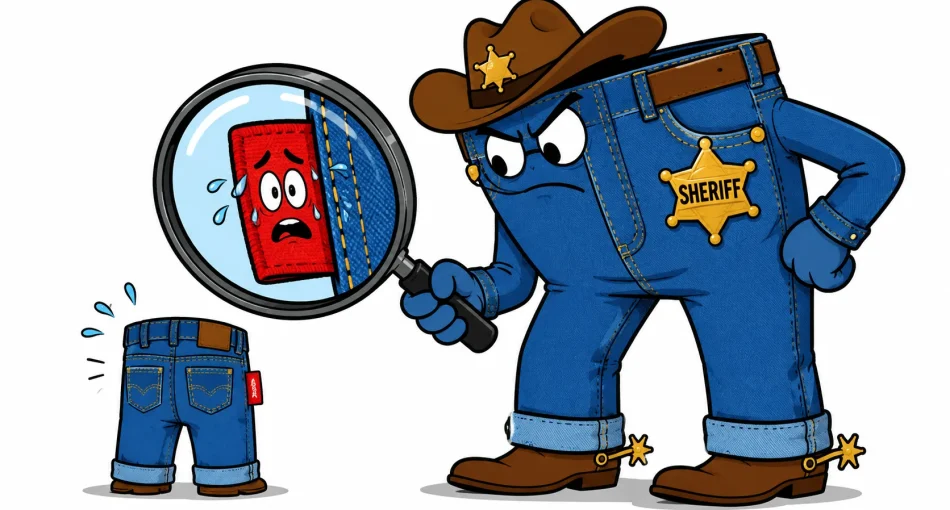
A tiny fabric tab sewn onto the edge of a back pocket just landed a clothing company in federal court. Levi’s has sued Australian company Globe and one of its brands, S-Double, claiming those little pocket tabs are “blatant copying” of a design Levi’s has used since 1936. No stolen logo. No copied name. Just a tab. And that is exactly why this case matters for your business.
This is a trade dress story, and trade dress is the part of trademark law that trips up apparel brands who think they’re safe because they invented their own name. You can build a brand from scratch, never touch a competitor’s word mark, and still get a cease-and-desist for the shape and placement of a design element. Let me explain how that works.
What Levi’s Is Actually Claiming
According to court filings in the Northern District of California, reported by The Guardian, Levi’s alleges trademark infringement, trade dress infringement, unfair competition, false advertising, and “blatant copying.” The target is S-Double, a brand founded in 2008 by Shawn Stussy and owned by Melbourne-based Globe.
Levi’s says its “Tab trademark is famous and recognised around the world” as a sign of “authentic, high-quality” garments, and that it was famous “long before Defendants began selling the products challenged in this Complaint.” These are allegations a court will decide, not findings of fact.
What makes this case spicy is the history. Levi’s says it brought the same claim against the same brand 15 years ago, settling a 2010 lawsuit after S-Double agreed to avoid selling pants with “a label or tab or tab-like device, regardless of shape or color, affixed in any manner on a vertical seam of a rear pocket.” That’s about as broad a promise as you can make.
Levi’s alleges S-Double then resumed selling clothes with “nearly identical” pocket tabs — red rectangular tabs on the outer edge of pockets, plus shirts with white tabs. The company says it notified S-Double and Globe in March 2026, demanded they stop and hand over sales data going back to 2011, and got no response.
Trade Dress: Protection for the Look, Not the Name
Here’s the legal term, plainly: trade dress is the overall look and feel of a product or its packaging that tells customers who made it. It can cover a shape, a color, a configuration of design elements — anything that functions as a source identifier rather than a brand name or logo.
Levi’s pocket tab is the textbook example. The company has explained on its website that it uses different colors and logos on its tabs, and deliberately leaves about one in ten completely blank to keep its trademark on the shape and placement of the tab itself. As Levi’s puts it, some companies “use a tab on their products but alter the name, attempting to argue that it’s not an imitation due to the name change” — and its blank Tab trademark is designed to shut down exactly that move.
That’s the trap. A small apparel brand might assume that as long as it isn’t printing “Levi’s” on anything, it’s clear. But if your design copies a protected non-verbal element — a tab in a specific spot, a stitching pattern, a recognizable silhouette — you can infringe without ever using a competitor’s words. This is why a real clearance search looks at more than just names.
Why “Famous” Changes the Math
Levi’s isn’t just claiming ordinary infringement. It’s leaning on fame. When a mark is famous, it gets broader protection, including against dilution — the idea that a famous mark can be harmed even without direct customer confusion. Levi’s alleges “incalculable and irreparable damage” to its goodwill, reputation, and standing with consumers.
For the design that’s been on jeans since 1936, fame is a fair argument to raise. That’s a problem for any brand sitting in the blast radius. Levi’s regularly files these suits — The Guardian notes Yves Saint Laurent and Brunello Cucinelli were among brands taken to court in recent years. This is not a company that lets pocket tabs slide.
What This Means for Your Apparel Brand
If you sell clothing, the lesson is to clear your design, not just your name. Before you finalize a hangtag placement, a contrast-stitched pocket, a back-patch, or any recurring visual signature, ask whether it echoes a famous brand’s protected look. Tabs, stripes, stitching shapes, and pocket configurations have all been fought over.
The S-Double history also shows what happens when you sign a settlement and then drift back toward the line. A settlement agreement is a contract. If Levi’s allegations are accurate, S-Double promised in 2010 to stop and then allegedly didn’t — which gives Levi’s both an infringement claim and a much angrier story to tell a judge. If you ever sign a coexistence or settlement agreement, treat its boundaries as permanent.
On the flip side, if you’ve built a distinctive non-logo design element of your own, you may be able to protect it. Trade dress can be registered, though it usually requires showing that customers actually associate the look with you. That’s a higher bar than registering a word mark, but for a serious brand it can be worth it. Start by understanding what you’re actually registering and how distinctiveness works.
The size gap here is striking — Levi’s is valued around $8.8bn, while Globe is worth roughly $71m. That’s a reminder that enforcement budgets are not evenly matched, and that getting your design cleared on the front end is far cheaper than defending it on the back end. If you receive a cease-and-desist over a design element, don’t ignore it the way the defendants here allegedly did; that silence rarely helps.
Worried a design choice might step on someone else’s trade dress — or want to protect a look you’ve built? Contact Harrigan IP for a flat-fee review. A thorough Comprehensive search and filing package looks beyond names so you don’t find out the hard way, and our infringement and enforcement help is here if a dispute is already on your desk. You can also read more about what to do when someone copies your brand.
Contct Us
Contact Us Today
"*" indicates required fields
Location
Harrigan IP
8117 Oak Street, Suite 203
New Orleans, LA 70118

Phone
© Copyright 2026 Harrigan IP. All rights reserved.