
Van Leeuwen v. Rebel: How a Paper Trail Won a $23.8M Trade Dress Case
Van Leeuwen v. Rebel: How a Paper Trail Won a $23.8M Trade Dress Case
By Brad Harrigan, Harrigan IP
A federal judge in New York just handed Van Leeuwen Ice Cream a sweeping win against Rebel Creamery, ordering the rival to redesign its pastel pints and cough up nearly $23.8 million in profits. The July 16 ruling came after a five-year fight over packaging, and the deciding factor was not a clever legal theory. It was a folder full of old design files.
That is the part worth slowing down on. Trademark law can protect the overall look and feel of your packaging, a concept called trade dress (the total visual impression of how a product is presented to buyers). And whether you win or lose can come down to something as unglamorous as whether you saved your drafts.
What Van Leeuwen actually claimed
Van Leeuwen sued Rebel in 2021, alleging the Utah-based low-sugar brand copied four features of its dairy pints: monochromatic cartons with matching lids, pastel colors, oversized black script, and minimalist layouts. Individually, none of those elements is special. Anyone can use a pastel color or a cursive font.
That is exactly the point most business owners miss about trade dress. The claim was never that Van Leeuwen owns pale pink or owns cursive. It is the specific combination of those elements, working together to create one recognizable commercial impression, that the law protects. Judge Eric Komitee’s ruling made a point of saying it does not give Van Leeuwen ownership of pastel colors, cursive lettering, or minimalist design on their own.
Van Leeuwen introduced this design in 2016, after hiring the design firm Pentagram to prepare the brand for national wholesale distribution. The firm researched competitors and presented seven concepts before the founders picked the final look. That backstory turned out to be gold.
The detail that won it
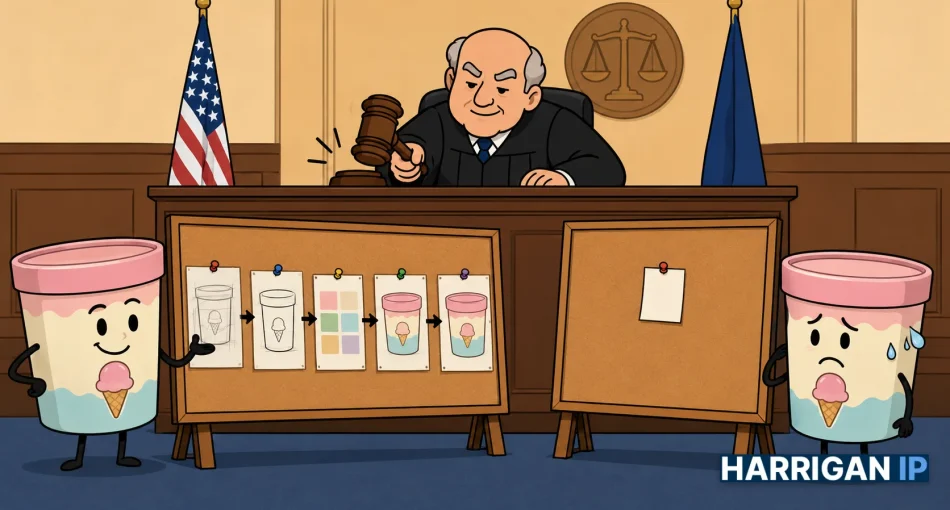
Pentagram kept everything: the briefs, the presentations, the design files, the rejected concepts, and each successive round of revisions. According to the partner who led the project and testified in the case, that archive was a record of authorship, a paper trail showing exactly how and when the design was created and why each choice was made.
Rebel’s paper trail was thinner. Its founders testified that they built their packaging in Adobe Illustrator but produced no sketches, no mockups, and no earlier versions, only the finished design. Judge Komitee found the probability that Rebel independently arrived at all those same choices was “infinitesimal,” and called the founders’ account of their process “clearly fabricated.”
Think about how that reads to a judge. One side walks in with a documented history of authorship. The other walks in holding the finished pint and asking the court to take its word for it. When the design decisions look identical and one party can’t show its work, the story tells itself.
The warning Rebel ignored
There was another fact that seems to have loomed large. A Wegmans buyer reportedly warned one of Rebel’s founders before the first retail launch that the cartons looked like Van Leeuwen’s. Rebel made no changes.
Courts differ on what counts as bad faith in a copying case. Some treat deliberate copying as enough; others want proof of an intent to confuse shoppers. A retailer flagging the resemblance and the defendant plowing ahead anyway is the kind of fact that pushes a judge toward the harsher reading. If a customer or a store buyer ever tells you your packaging looks like someone else’s, that is a moment to investigate, not to shrug off. Documenting how you responded to a warning like that can matter as much as documenting the original design.
Reverse confusion: when the original looks like the copycat
One of the more interesting findings here involves reverse confusion (when a larger or faster-growing junior brand floods the market so thoroughly that consumers start to think the original, senior brand is the imitator). The court found that Rebel’s expansion into major retailers could lead shoppers and buyers to believe Van Leeuwen was the copycat. A Publix buyer reportedly raised confusion concerns and then declined to stock Van Leeuwen.
That is the nightmare scenario for a smaller brand. You created the look first, but a better-funded competitor scales past you and now you look like the knockoff of your own design. A survey commissioned by Van Leeuwen found a 34.3 percent net-confusion rate, meaning roughly a third of surveyed ice cream shoppers associated Van Leeuwen with Rebel because of the packaging. Survey evidence like that often does heavy lifting in infringement cases, because it turns a gut feeling about confusion into a number.
How the court got to $23.8 million
Figuring out exactly which sales a company lost to look-alike packaging is genuinely hard. Purchasing decisions turn on price, flavor, diet preferences, and where the product is stocked. So courts often use the defendant’s profits as a stand-in.
That is what happened here. The judge calculated Rebel’s profits from the affected pints at $35.5 million, then cut the award by 33 percent to account for demand that came from Rebel’s keto and “better-for-you” positioning rather than the packaging. The result was the $23.785 million judgment, which is a disgorgement of Rebel’s profits, not an estimate of Van Leeuwen’s own losses.
Two honest caveats. This is a district court decision, so it does not bind other courts, and as of the reporting Rebel had not said whether it would appeal. Trade dress claims built on “contemporary aesthetic” can be a hard sell, because some courts are reluctant to let one company fence off a popular style. Van Leeuwen got there on the strength of its record, its documented sales growth after the redesign, and the press its packaging earned.
What this means for your brand
You do not need a $23 million verdict to take the lesson. If your product lives on a shelf, your packaging is a business asset, and the way you prove you own it starts long before anyone gets sued.
Save your briefs, your rejected concepts, your dated drafts, and your revision rounds. That archive is your record of authorship. Pair it with a federal registration where you can get one, keep evidence of press and sales tied to the look, and take retailer warnings seriously. If you’re weighing whether to protect a logo, a word mark, or the broader look of your product, it’s worth understanding how each type of protection works before you file. And if a copycat does show up, a documented trail is what separates a strong enforcement case from a shrug.
Want to protect the look and name of your brand before a competitor borrows it? Get in touch with Harrigan IP to talk it through, or start with our flat-fee trademark registration. Already on the shelf and worried about copycats? Our trademark monitoring service watches for look-alikes so you can act early. For more, see our guide to how strong brands defend their identity.
Get startedQuestions? Talk to Harrigan IP
Contct Us
Contact Us Today
"*" indicates required fields
Location
Harrigan IP
8117 Oak Street, Suite 203
New Orleans, LA 70118

Phone
© Copyright 2026 Harrigan IP. All rights reserved.