
7-Eleven v. Nike: A Trade Dress Lesson Hiding in Three Colors
7-Eleven v. Nike: A Trade Dress Lesson Hiding in Three Colors
By Brad Harrigan, Harrigan IP
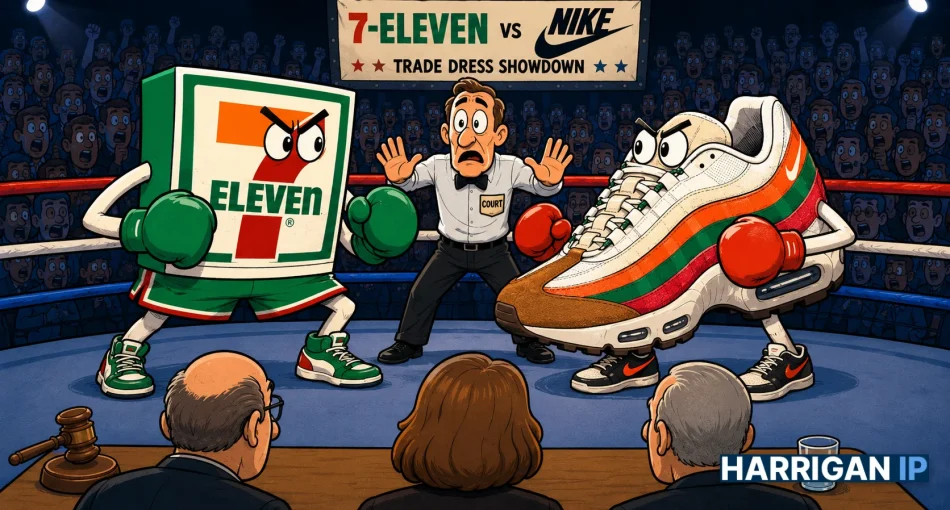
Nike is being sued by 7-Eleven, and the whole fight comes down to red, green, and orange. According to a report on the filing, the convenience store chain claims a new Nike Air Max 95 Big Bubble in a “Sport Green and Safety Orange” style copies the colors that have said “7-Eleven” to shoppers for generations. If you’ve ever wondered whether a brand can own a color scheme, this case is a clean, real-world example of trademark law stretching well past logos and names.
The lawsuit was filed Wednesday in the Northern District of Texas, where 7-Eleven is based. It alleges that the sneaker’s side striping — rendered in a red, green, and orange combination — mirrors the alignment of 7-Eleven’s branding and infringes what the company calls its “Tri-Color Mark.” The timing didn’t help Nike’s case in 7-Eleven’s eyes: the shoes were scheduled to drop July 11, the same day the chain runs “7-Eleven Day” and “Free Slurpee Day.”
What Trade Dress Actually Is
Most people think of a trademark as a word or a logo. But trademark law also protects trade dress — the overall look and feel of a product or brand that consumers use to identify who’s behind it. That can include packaging, a store’s interior design, a product’s shape, and yes, a distinctive combination of colors.
The key word is distinctive. A single ordinary color is hard to claim, and functional features (a color chosen because it works better, not because it identifies a brand) generally can’t be locked up at all. But a specific, arbitrary color arrangement that the public has come to associate with one company can qualify for protection. That’s the theory 7-Eleven is running on: those three colors, in that order, point to them.
Trade dress isn’t automatic. To enforce it, a brand generally has to show that the look is distinctive — either inherently, or through what’s called “secondary meaning,” where consumers have learned to connect the design with a single source over years of use. Decades of red-green-orange storefronts and Slurpee cups give 7-Eleven a real argument on that front.
The Core Question: Likelihood of Confusion
Every infringement case, whether it’s over a word, a logo, or a color scheme, turns on the same central question: is confusion likely? Would an ordinary consumer see the Nike shoe and assume 7-Eleven made it, sponsored it, or teamed up on it?
7-Eleven’s complaint leans hard into that idea. It alleges that “Nike’s infringement is a deliberate and willful effort to associate its footwear with 7-Eleven by copying or imitating the Tri-Color Mark,” and that the practices “likely will cause — and indeed already have caused — confusion among the public.” Those are allegations, not findings. A court will decide whether the colors are protectable trade dress and whether shoppers are actually confused.
Nike, for its part, has plenty of room to push back. The shoes reportedly carry no official connection to the retailer, and Nike may argue the color combo is aesthetic or common enough that no reasonable buyer thinks the swoosh brand is suddenly selling Slurpees. The complaint also says 7-Eleven “repeatedly” tried to resolve the matter before filing — a detail that often shows up when a plaintiff wants to frame the other side as unreasonable.
Why a Sneaker Fight Matters to Small Brands
You don’t need Nike’s ad budget or 7-Eleven’s store count for trade dress to matter to you. If your business has a signature look — a color combination on your packaging, a recognizable storefront layout, a distinctive product shape — that look may be part of what customers use to find you. And that means a copycat can chip away at it.
The lesson isn’t “go trademark a color tomorrow.” It’s that your brand identity is broader than your name and logo, and the strongest protection comes from choosing distinctive elements and using them consistently. The more arbitrary and consistent your look, the easier it is to argue it points to you and only you. That’s the same principle behind choosing a strong trademark in the first place.
It also helps to understand where color and design sit in the broader system. A word mark and a logo are usually the foundation, and there’s a real strategic question about whether to register the word mark, the logo, or both. Trade dress often sits alongside those registrations rather than replacing them, protecting the parts of your brand a plain word mark can’t reach.
Enforcement Is Where It Gets Real
Owning distinctive trade dress is one thing. Enforcing it is another. 7-Eleven’s case shows the usual sequence: you spot a problem, you try to resolve it directly, and if that fails, you go to court. That’s true whether the infringer is a global brand or a local competitor down the street.
The practical takeaway for smaller businesses is to catch problems early, before a copycat’s version gets established in customers’ minds. That’s exactly why trademark monitoring exists — so you learn about a lookalike while you still have leverage, not after it’s built its own following. Once confusion sets in with the public, unwinding it is expensive and slow.
Whether 7-Eleven wins may hinge on how distinctive a court finds three colors on a shoe stripe, and whether those colors genuinely signal a source or are just, well, colors. But the framework is the same one that protects a corner bakery’s box or a boutique’s storefront: distinctive look, consumer recognition, likelihood of confusion. Trade dress is one of the quieter corners of trademark law, and cases like this one are the easiest way to see it work.
Worried your brand’s signature look could be copied — or already has been? Get in touch with Harrigan IP to talk it through. If you’re ready to lock down the name and logo behind your brand, our Comprehensive registration package is a solid place to start, and our trademark monitoring service helps you catch copycats while you still have room to act. For more, see what happens if someone infringes your trademark.
Get startedQuestions? Talk to Harrigan IP
Contct Us
Contact Us Today
"*" indicates required fields
Location
Harrigan IP
8117 Oak Street, Suite 203
New Orleans, LA 70118

Phone
© Copyright 2026 Harrigan IP. All rights reserved.