
Molly Tea’s Franchise Fight: How a Brand Operator Lost Its Own Name
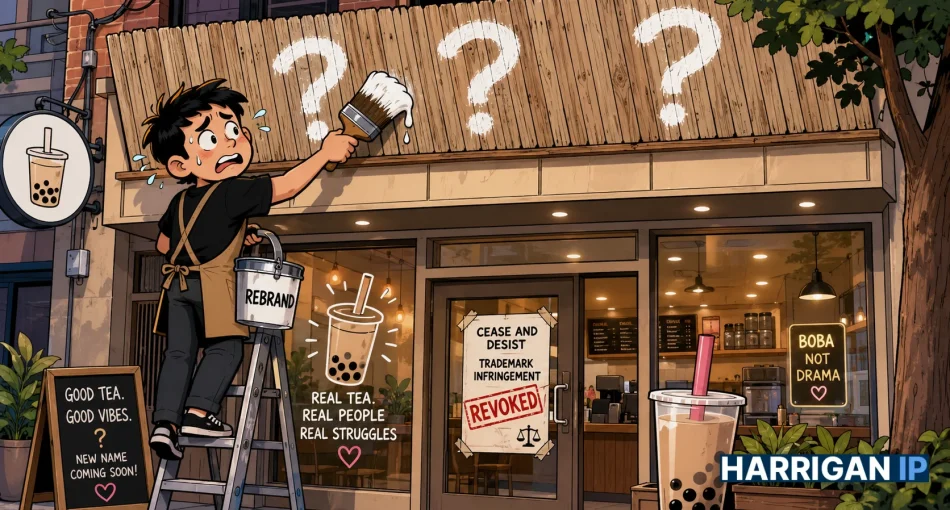
Molly Tea’s Franchise Fight: How a Brand Operator Can Lose Its Own Name
By Brad Harrigan, Harrigan IP
Few things sting a small business owner like building up a popular location, then being told you can no longer use the name on the sign out front. That is the worst-case outcome of a franchise trademark dispute — the brand you poured your sweat into turns out to be borrowed, and the lender can call it back.
The recent closures of several Molly Tea locations in New York and the San Gabriel Valley have people online speculating about why a buzzy chain went dark so fast. I love a good cup of tea, but I love a good legal fight even more. So instead of repeating the social media rumors, let me walk through what the publicly filed court records actually allege — and, more importantly, what your business should learn from it.
What the Court Filings Actually Claim
According to publicly accessible federal court dockets, the Molly Tea parent company sued its New York-based operators, alleging the operators breached their agreement and, as a result, lost the right to use the brand. I want to be careful here: these are allegations a court will decide, not proven facts. The operators have not had their day in court as of this writing, and nothing below is a finding of wrongdoing.
The parent company’s complaint reportedly claims the operators set up a separate, unauthorized entity and bank accounts and routed store profits through it to dodge a contractually required profit-sharing arrangement with corporate. The filings also allege the operators expanded beyond the five New York stores their agreement permitted — opening in Los Angeles without authorization — and stopped using the approved corporate supply chain in favor of unapproved ingredients.
There is also a separate trademark lawsuit in California, filed by a local tea wholesaler against the Molly Tea operators. That kind of collateral fight is exactly what happens when an operator expands into a new market without doing local clearance work first.
The upshot, per the filings: corporate moved to revoke the operators’ trademark rights, a court entered a temporary restraining order against the operators, and the locations closed.
How a Franchisee Can Lose the Right to a Name It Never Owned
Here is the part that surprises non-lawyers. In almost every franchise relationship, the franchisee never owns the trademark. The franchisor (the brand’s parent company) owns the mark and grants the franchisee a license — permission to use the name under specific conditions.
A trademark license is conditional by nature. When the franchisee breaks the conditions, the license can be terminated, and the right to use the name evaporates. That is not a quirk of one contract; it is how brand licensing is built to work. If you want a primer on the underlying asset, see our explainer on what a trademark actually is.
Two conditions matter most in disputes like this. First, payment and reporting terms — profit-sharing, royalties, honest books. Hide revenue from the franchisor and you’ve handed them a textbook breach. Second, quality control. A franchisor is legally required to police how the mark is used, including the consistency of the product. When an operator swaps in unapproved ingredients, the franchisor isn’t just annoyed — it may have to act to protect the mark or risk weakening its own rights.
Why Quality Control Is a Legal Obligation, Not Corporate Nitpicking
Trademark law treats a brand owner who lets licensees do whatever they want as having committed “naked licensing” — licensing the mark without controlling the quality of the goods or services behind it. Naked licensing can cause the owner to lose the trademark entirely. So when corporate insists on approved suppliers and recipes, that isn’t bureaucracy for its own sake. It’s the franchisor protecting an asset it has a duty to police.
For the operator, that means “the tea tasted a little different at my location” can become a contract violation with real teeth. Consistency clauses exist precisely so that a customer in Los Angeles gets the same experience as a customer in New York — and so the franchisor can defend the brand.
The Hidden Trap: Expanding Into a New Market Without Clearance
The California lawsuit against the operators is a warning all by itself. When you move a brand into a new region, you can collide with a business already using a similar name or logo there — even one you’ve never heard of. That’s a classic infringement exposure.
A national franchisor’s federal registration helps, but it doesn’t make local due diligence optional, and it certainly doesn’t help an operator who expanded outside the scope of the agreement. This is why a real clearance search before entering any new market is non-negotiable, whether you’re a franchisee or running your own brand. Skipping it is how you end up defending a lawsuit you never saw coming. Our guide on searching before you file walks through what that work involves.
What This Means for Your Business
If you’re a franchisee or you license a brand, read the trademark provisions of your agreement like your livelihood depends on them — because it does. Know exactly what conduct lets the other side terminate your license, what your reporting and quality obligations are, and what happens to your locations the day the license ends. Surprises in that clause are the difference between a tough negotiation and a locked front door.
If you’re on the other side — building a brand you plan to license or franchise — the lesson flips. You need to actually own your mark, ideally through federal registration, and your agreements need clean assignment and license terms plus enforceable quality-control standards. A well-drafted agreement is what let the Molly Tea parent company, by its own account, pull brand rights when things went sideways. Without that paper, you may have no leverage at all.
And if you’re a small business owner who has never franchised anything, there’s still a takeaway here. Own your name. Register it. Don’t operate on a handshake assumption that the brand is “yours” when the documents say otherwise. If you’re weighing whether to lock down your mark now or later, our piece on filing before or after you start is a good place to begin.
The fastest way to find out whether someone could one day yank your brand out from under you is to map who actually owns it on paper today. If you’re not certain, reach out to Harrigan IP — I’m a flat-fee trademark attorney, so you’ll know the cost up front. If you’re ready to secure your own name, take a look at the Comprehensive registration package, and if you want to catch conflicts before they become lawsuits, our trademark monitoring service keeps watch so you don’t have to.
Get startedQuestions? Talk to Harrigan IP
Contct Us
Contact Us Today
"*" indicates required fields
Location
Harrigan IP
8117 Oak Street, Suite 203
New Orleans, LA 70118

Phone
© Copyright 2026 Harrigan IP. All rights reserved.