
Cleveland Golf v. Callaway: When a Founder’s Name Becomes a Brand You No Longer Own
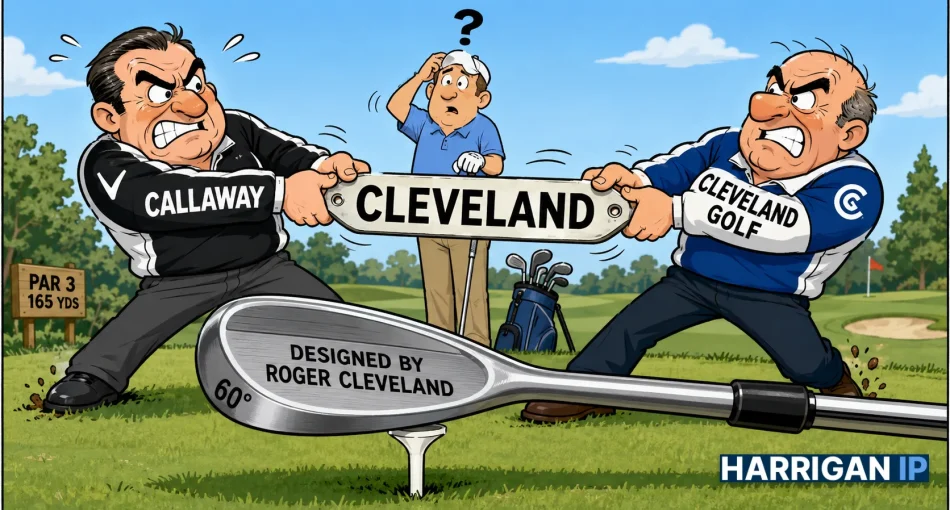
Cleveland Golf v. Callaway: When a Founder’s Name Becomes a Brand You No Longer Own
By Brad Harrigan, Harrigan IP
Here is a question that sounds absurd until a lawyer makes you sweat over it: can a company stop a man from putting his own name on a product he designed? That is the heart of a lawsuit between Cleveland Golf and Callaway, and it is a sharp lesson for any small business owner who wants to trademark a founder’s name.
According to a report on GolfWRX, Cleveland Golf Company and Dunlop Sports Co. sued Callaway Golf for trademark infringement, unfair competition, and trademark dilution. The trigger was a line printed on the back of Callaway’s Mack Daddy 2 wedges: “DESIGNED BY ROGER CLEVELAND.”
The twist is that Roger Cleveland really did design them. He is a respected wedge designer who founded the Roger Cleveland Golf Company, then went to work for Callaway. So why is one company suing another for telling the truth about who designed a club?
How a Person’s Name Becomes a Company’s Property
Per the source, in 1990 Roger Cleveland sold all of his shares and ownership interest in the company he founded. He later left and joined Callaway in 1996. When the Mack Daddy 2 wedges came out with his name on them, Cleveland Golf was, in the words of the report, “understandably not thrilled.”
A trademark is a word, name, or symbol that tells customers who stands behind a product. The moment a personal name starts doing that job, the law treats it as a brand asset rather than just the name on a birth certificate. That is the trap so many founders fall into.
Cleveland Golf is alleged to own multiple federally registered trademarks, and the company claims Callaway’s use of the Cleveland name infringes them. The complaint reportedly argues that putting “Roger Cleveland” on a Callaway wedge confuses the marketplace and misleads consumers into thinking the wedge is affiliated with, or came from, Cleveland Golf. (These are allegations; a court will decide who is right.)
I walked through this exact pattern in a recent piece on what happens to your name when you sell a business. The short version: when you sell a company, the buyer is paying for the brand right alongside the desks and the customer list. If your name was registered as a trademark by that business, the registration goes with the sale. You can walk away with the check and still walk away without the rights to your own name.
The Real Fight: Consumer Confusion, Not Wounded Pride
It is easy to read this story as Cleveland Golf being thin-skinned. But trademark law does not actually care about hurt feelings. It cares about whether customers are likely to be confused about who made the product.
That is the standard that drives most infringement disputes. If a golfer sees “Cleveland” on a wedge and assumes Cleveland Golf is behind it, that confusion is the legal harm, no matter how honest Callaway’s intentions were. The company’s name and the man’s name are the same word, and that overlap is exactly what makes the case live rather than frivolous.
There is a real defense on the other side, though. US trademark law recognizes an “own name” defense and a related concept called descriptive use, which generally lets a person identify themselves truthfully as the creator of new work. Crediting yourself as the designer is usually fine. Rebuilding your old brand by stealth is not.
That is the line every founder needs to understand. “Designed by Roger Cleveland” as a small credit on the back of a club looks a lot like descriptive use. The question a court would weigh is whether, in context, that line functions as an honest acknowledgment or as a backdoor trade on the goodwill the original Cleveland Golf brand built. The placement, the prominence, and the surrounding marketing all matter.
Contracts Beat Common Law
Here is the part that tends to decide these cases, and it has almost nothing to do with the jokes about whether anyone still buys Cleveland wedges. When Roger Cleveland sold his shares and ownership interest in 1990, he and the buyer signed documents. Those documents, the assignments and any restrictions on future use, usually control the outcome.
There is plenty of common-law nuance around a person’s right to use their own name, and it is genuinely not as simple as most people assume. But general legal rights get overridden by rights assigned in a contract. If the sale agreement transferred the rights to the Cleveland name as a brand and limited what Roger could do later, that paperwork carries more weight than any feel-good argument about a name your parents gave you.
This is why I keep telling clients that the worst time to think about name rights is after the deal closes. Whether you are filing before or after you start a business, or eyeing an eventual sale, you want to decide early what you are selling and what you are keeping. Sometimes the smart move is a carve-out or a license that lets you keep using your name in defined ways. Sometimes it is a coexistence arrangement that spells out who can use the name where.
What This Means for Your Business
If your brand is built around your personal name, treat that name like the asset it is, not like a permanent birthright. Once it identifies your products in the market, it is a brand, and a brand can be sold, licensed, or lost.
Three practical takeaways. First, before you register a personal name as a trademark, understand that the registration may someday belong to a buyer, not to you. Second, if you ever sell, negotiate exactly what happens to your name while you still hold the leverage, which is before you sign. Third, if you hire a namesake designer or founder away from a competitor, get clear on who owns the right to use that person’s name commercially before you print it on anything.
Callaway and Cleveland Golf can afford to fight this out. A small business usually cannot. The cheaper path is to get the name rights nailed down on the front end, in writing, before a wedge, a label, or a website ever carries your name.
If you are building a brand around your own name, or thinking about selling one, talk to us before you commit. Harrigan IP is a flat-fee trademark firm, so you will know the cost up front. Lock in your rights with our Comprehensive registration package, and if a competitor is already using your name, our trademark monitoring service can flag it before it turns into a lawsuit.
Get startedQuestions? Talk to Harrigan IP
Contct Us
Contact Us Today
"*" indicates required fields
Location
Harrigan IP
8117 Oak Street, Suite 203
New Orleans, LA 70118

Phone
© Copyright 2026 Harrigan IP. All rights reserved.