
John Oliver vs. Buc-ee’s: When Trademark Policing Becomes Bullying
John Oliver vs. Buc-ee’s: When Trademark Policing Becomes Bullying
By Brad Harrigan, Harrigan IP
A late-night comedian just dared one of the most litigious brands in the country to take him to court. On the July 26 broadcast of HBO’s Last Week Tonight, John Oliver spent a chunk of airtime on Buc-ee’s, the beloved Texas mega gas station chain that dazzled some FIFA World Cup visitors — and then turned to something less flattering: the company’s habit of suing smaller businesses over its trademarks.
According to USA TODAY’s reporting, Oliver noted that Buc-ee’s is known for bringing trademark litigation against other convenience stores, T-shirt companies, and even an underwear brand called “Nut Huggers.” His broader point: the company tends to win because its targets are smaller and lack the resources to fight back.
That dynamic has a name in trademark circles. It’s called trademark bullying — and Oliver’s stunt is a national-TV crash course in what it is, when aggressive enforcement crosses a line, and what a small business can actually do when a giant comes knocking.
What Oliver Actually Did
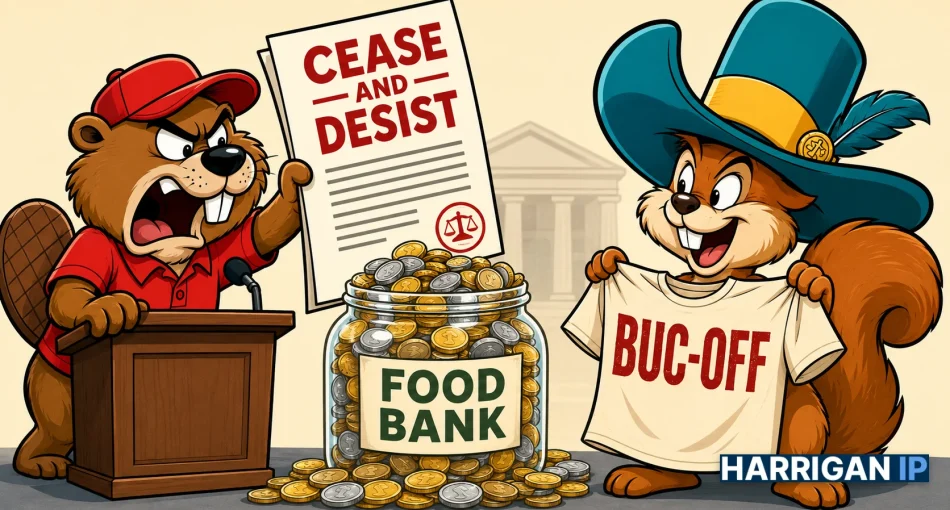
Oliver didn’t just complain. He launched a merch line called “Buc-Off” built around the show’s squirrel mascot, Mr. Nutterbutter — a character the segment openly acknowledged bears a resemblance to the Buc-ee’s logo. He then invited Buc-ee’s to sue him.
The twist is what makes it clever. Proceeds from the merch go to Hunger Free America. As Oliver put it on air, “Remember, in doing so, you’ll be directly taking food out of hungry people’s mouths.” He closed the show standing in front of a parody Buc-ee’s gas station, complete with a bronzed statue of Mr. Nutterbutter and a mascot wearing a hat for, in his words, “completely arbitrary” reasons.
The gear — T-shirts, pajama pants, boxers, socks, stickers, and more — is being sold on buc-off.com and is only available until Sept. 8. USA TODAY reported that it reached out to Buc-ee’s for comment. So this is a live dare, structured to make suing look like a PR disaster.
Why This Isn’t Legal Advice From a Comedian
Here’s the part worth saying plainly: John Oliver has a legal budget, a global platform, and — as he cheerfully admitted — the will to fight. Most small businesses have exactly none of those things. His whole bit works because he’s the rare defendant a brand like Buc-ee’s can’t easily steamroll.
That’s the real lesson. Buc-ee’s usually wins not because every case is a slam dunk, but because the other side can’t afford the fight. A cease-and-desist letter — a demand letter telling you to stop using a mark — lands very differently when you know litigation could cost six figures. Plenty of legitimate businesses fold on marks they might have been entitled to keep, simply because folding is cheaper than fighting.
I’ve written about Buc-ee’s enforcement before, because this pattern keeps repeating. When the chain went after a Texas competitor with a similar beaver-and-name setup, it made for a genuinely close case — see my breakdown of the Buc-ee’s v. Barcee’s lawsuit. And when Buc-ee’s leaned on common-law rights rather than a registration, that’s a different flavor of the same aggressive posture I dug into in the common-law trademark piece featuring Burger King. The through-line: big brands protect turf hard, and how they do it matters.
Where Legitimate Policing Ends and Bullying Begins
Let’s be fair to trademark owners for a second. The law actually requires you to police your mark. If you sit back and let others use something confusingly similar, your rights can weaken — a mark that’s allowed to sprawl loses its power to identify a single source. Sending demand letters and, when necessary, filing suit is a normal, legitimate part of owning a brand.
The core legal test is likelihood of confusion: whether an ordinary consumer would likely be confused about who makes or sponsors a product. Courts weigh how similar the marks are, how related the goods are, how strong the senior mark is, and more. When two convenience stores use similar beaver mascots and similar names, that’s a real confusion question worth litigating.
Trademark bullying is different. It’s when an owner uses its trademark to harass or intimidate beyond what the law reasonably supports — reaching for goods that aren’t related, marks that aren’t actually confusing, or defendants operating in entirely different lanes, and counting on the fact that the target can’t afford to say no. The USPTO itself has studied the phenomenon of overreaching enforcement. The tell is usually the gap between the legal claim and the economic pressure: a weak case backed by a strong threat.
Oliver’s underwear example is instructive. Whether “Nut Huggers” underwear is genuinely likely to be confused with a gas station chain is a real question — and reasonable people can disagree. But the pattern he’s calling out is the pressure, not the merits.
What a Parody Defense Does and Doesn’t Cover
Oliver is betting on parody, and it’s a real doctrine — but it’s narrower than people assume. Parody can be a defense to trademark infringement and to dilution (the weakening of a famous mark) when the new work clearly comments on or pokes fun at the original rather than simply borrowing its goodwill to sell stuff.
The catch: courts look hard at whether you’re actually making a point or just using a famous logo as decoration to move product. Selling T-shirts and boxers that riff on a well-known mascot sits right on that line. I’ve walked through where humor gets protection and where it doesn’t in nominative fair use and famous trademarks and dilution. Oliver’s segment is loud, obviously commentary, and tied to a charity — which strengthens the “we’re making a point” argument. Your average small merch shop copying a logo doesn’t get that same halo.
If a Big Brand Sends You a Demand Letter
Say you’re the small business on the receiving end. What actually helps?
First, don’t panic and don’t ignore it. A cease-and-desist is an opening move, not a court judgment. The letter is written to sound apocalyptic; that’s its job. Your job is to figure out whether the underlying claim is strong or thin.
Second, get an honest read on likelihood of confusion. Are the goods actually related? Are the marks truly similar to an ordinary buyer, or does the sender’s mark just happen to share a word or a theme? Sometimes the claim is real and the smart move is to change course. Sometimes it’s overreach, and a firm, well-drafted response ends the matter — a surprising number of demand letters go quiet when the target answers with an actual legal argument instead of a panic-attack. If it does go the distance, that’s what enforcement disputes look like from the inside.
The Best Defense Is Filed Before the Fight
The strongest position in one of these standoffs isn’t a clever comeback. It’s a clean registration and a name you cleared before you built a brand around it.
Two moves matter most. Run a real clearance search before you commit to a name, so you’re not building on someone else’s territory in the first place. And register your own trademark, so you’re the one holding federal rights instead of relying on hope. A registered mark turns you from an easy target into a party with leverage.
The same logic runs the other direction, too. Legitimate brand owners police their marks because they have to — and a trademark monitoring service is how you catch genuine problems early, while they’re still cheap to address, rather than years later when a copycat has built real market share. The goal isn’t to bully anyone. It’s to know what’s happening to your brand and respond in proportion.
The Takeaway
Oliver’s stunt is entertainment, and it’s built for a defendant who can absorb a lawsuit and turn it into content. Most businesses can’t. But the point underneath is legitimate: aggressive enforcement is normal, overreaching enforcement isn’t, and the line between them is exactly the kind of question you want a trademark lawyer to answer before you either send a scary letter or cave to one.
Whether you’re the small brand worried about a demand letter or the growing brand that needs to protect what it built without becoming the villain in someone’s comedy special, the answer is the same: know your rights, clear your name, and register it.
Facing a cease-and-desist, or want to make sure your brand can stand its ground? Reach out to Harrigan IP for a straight answer. If you’re ready to lock in federal rights, our flat-fee Comprehensive registration package covers clearance and filing in one shot — and if you want to keep an eye on copycats without becoming a bully about it, ask us about trademark monitoring. Want more Buc-ee’s background? Start with the Buc-ee’s v. Barcee’s breakdown.
Get startedQuestions? Talk to Harrigan IP
Contct Us
Contact Us Today
"*" indicates required fields
Location
Harrigan IP
8117 Oak Street, Suite 203
New Orleans, LA 70118

Phone
© Copyright 2026 Harrigan IP. All rights reserved.