
Tesla Files a Trademark for Its Diner — and It’s the Building’s Curvy Bar
Tesla Files a Trademark for Its Diner — and It’s the Building’s Curvy Bar
By Brad Harrigan, Harrigan IP
Tesla is best known for cars, batteries, and its CEO’s social media habits. But on August 10, 2026, the company filed a Tesla restaurant trademark application at the USPTO — Serial No. 50042427 — covering full-blown restaurant services. Yes, really.
Before anyone panics that Elon is coming for the diner business, here’s the grounding fact: this restaurant already exists. The Tesla Diner opened in West Hollywood in July 2025 as a Supercharger station with a place to grab a bite. The application isn’t announcing a new venture. It’s protecting one that’s already up and running.
What Tesla Actually Filed
The application sits in International Class 043, the class for food and drink services. The listed services read like a diner menu of legal descriptions: “restaurant services,” “self-service restaurant services,” “providing food and beverages for consumption on and off the premises,” and — my favorite — “restaurant services featuring food and beverages orderable from vehicles and served for consumption in vehicles.”
That last one is the Tesla twist. This is a place where you order from your car and eat in it, which lines up with how a Forbes review of the Diner described the actual customer experience: most people charge, order to the car, and go. The application also covers “providing social meeting, banquet and social function facilities.”
Tesla filed on a Section 1(a) basis — “use in commerce” — meaning it’s claiming the mark is already in real-world use, not merely planned. The claimed first-use date is July 21, 2025, which tracks with the Diner’s opening. When you file based on actual use, you have to submit a specimen (a real-world sample showing the mark in use with the services), and the application references photos doing exactly that.
Here’s the Surprising Part: There’s No Name
Read the filing closely and you’ll notice the “Mark” field says “No wording.” This isn’t a trademark on the word “Tesla” or on “Tesla Diner.” It’s something else entirely.
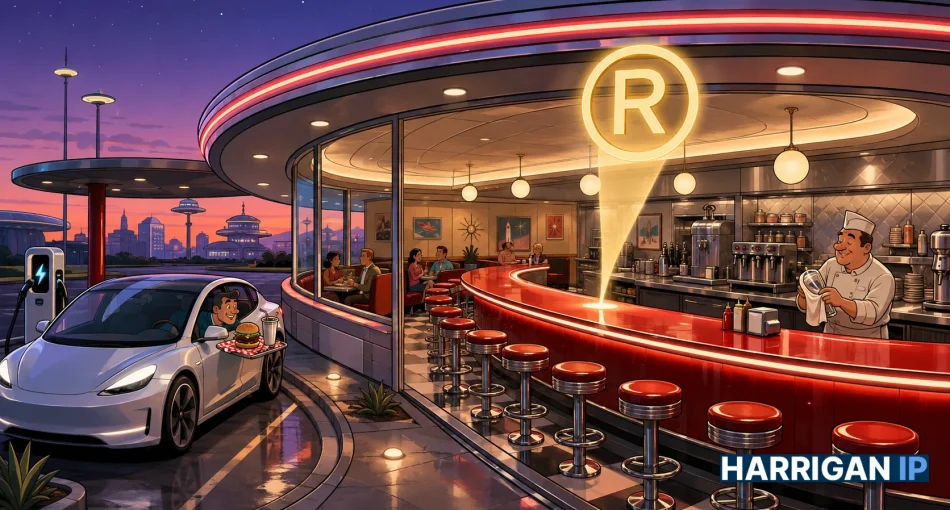
The mark format is listed as “product packaging,” and the description spells it out: “three-dimensional trade dress comprising the overall configuration of an exterior dining-area bar, including a curved, smooth, continuous bar surface positioned along and following the curvature of the restaurant building.”
In plain English, Tesla is trying to trademark the shape and look of its diner’s curved bar. That’s called trade dress — protection for the overall visual appearance or design of a product or space, as opposed to a name or logo. Think of the layout of a well-known burger chain’s dining room, or the distinctive shape of a soda bottle. When the look itself signals a source to customers, it can function as a trademark.
Why Trade Dress Is a Tougher Climb
Filing for the shape of a building’s bar is more ambitious than registering a word or logo, and there’s a reason for that. To register trade dress for the design or configuration of a product, an applicant generally has to show the design is non-functional and that it has acquired distinctiveness — meaning customers have come to recognize that specific shape as pointing to one particular business.
A design that exists mainly because it works well, or that any competitor would need to compete, usually can’t be locked up. A curved bar that follows the curve of a building could invite an examiner’s question: is this shape a source identifier, or just architecture doing its job? That’s the kind of issue that surfaces in an office action, the USPTO’s formal letter raising legal problems with an application.
Interestingly, the application as filed doesn’t appear to include a claim of acquired distinctiveness under Section 2(f) — the provision applicants often lean on to show a design has earned its trademark stripes through use and recognition. A diner that opened in July 2025 is young for that argument. Whether Tesla adds one later, or points to the fame of the broader brand, is something to watch as the file develops.
What Food-Business Owners Can Take From This
You don’t need 80 Superchargers to learn something here. Two lessons stand out for anyone running a restaurant, café, or food truck.
First, your brand is bigger than your name. The layout of your space, a signature counter design, a distinctive color scheme — these can be protectable as trade dress if they genuinely identify your business to customers. That’s a real asset, but it’s also a harder registration to win than a straightforward word mark, so most food businesses should start with the name and logo and treat trade dress as a later, more specialized move.
Second, file in the right class for what you actually do. Tesla filed in Class 043 because that’s where restaurant services live. If you’re launching a food concept, your name belongs in the correct international class — and if you sell branded merchandise or packaged goods too, that may mean additional classes. Getting the goods-and-services description right is the difference between a registration that protects you and one that protects a category you don’t operate in.
And if a big company files something near your brand, you want to know before it registers, not after. Watching new applications lets you object early — through a letter of protest or an opposition — while the timing is still on your side.
Curious whether a filing like this could affect your own brand? Get in touch with Harrigan IP and we’ll take a look. If you’re ready to lock down your restaurant name the right way, our flat-fee trademark registration gets your mark filed in the correct class, and our trademark monitoring service flags new filings that crowd your space so you can act while there’s still time. Want more on protecting your look? Read our take on famous marks and how they’re protected.
Get startedQuestions? Talk to Harrigan IP
Contct Us
Contact Us Today
"*" indicates required fields
Location
Harrigan IP
8117 Oak Street, Suite 203
New Orleans, LA 70118

Phone
© Copyright 2026 Harrigan IP. All rights reserved.