
University of Texas v. a Corpus Christi Butcher: Why the Longhorn Logo Fight Is a Warning to Every Local Shop
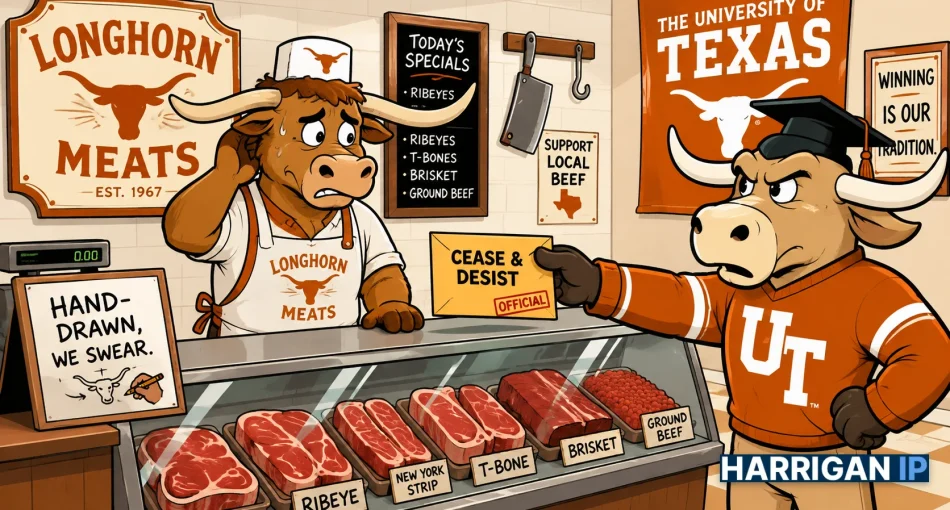
University of Texas v. a Corpus Christi Butcher: Why the Longhorn Logo Fight Is a Warning to Every Local Shop
By Brad Harrigan, Harrigan IP
The University of Texas Board of Regents has taken a small Corpus Christi butcher shop to federal court, and the fight is over one thing: a steer. According to a trademark infringement lawsuit filed in the Southern District of Texas in July 2026, UT accuses Staples Street Meat Market and its owner, Michael Meehan, of using a Longhorn silhouette that copies the school’s famous logo. The shop, by the reporting, has hundreds of Google reviews and tens of thousands of Facebook followers — hardly a national brand, and exactly the kind of small business that assumes a giant like UT would never notice.
That assumption is where a lot of owners get into trouble. Universities and sports franchises run some of the most aggressive brand-enforcement programs in the country, and “we’re just a little local shop” is not the shield people think it is. So let’s walk through what UT is actually claiming, what the meat market’s best arguments are, and the lesson the rest of us should take from it.
What the Longhorn logo lawsuit actually claims
Trademark infringement is, at its core, about one question: is the public likely to be confused about who is behind a product? UT argues that its Longhorn logo has been used “extensively” for decades, that it’s “inherently distinctive,” and that it tells consumers a product comes from the University. When a butcher shop puts a similar longhorn silhouette on merchandise, UT says, customers may reasonably assume the school endorsed or licensed it.
The suit also leans on the word “famous.” A famous trademark gets extra protection under a doctrine called dilution, which lets the owner stop uses that blur or tarnish the mark even without proving classic customer confusion. If a court agrees the Longhorn logo is famous, UT doesn’t necessarily have to show that anyone thought the meat market was selling official Texas gear — the mere weakening of the logo’s uniqueness can be enough.
On the remedy side, UT wants the shop to stop using the logo and wants an “accounting” — a legal process to figure out how much money the business allegedly made off the logo, so that profit can be handed over. That’s a common one-two punch in these cases: kill the use, then claw back the gains.
“My son drew it from scratch” — does that help?
Meehan told the Houston Chronicle that his son drew the meat market’s longhorn from scratch and that he repeatedly told UT it isn’t the Longhorns mark. I understand the instinct completely, but here’s the hard truth: original artwork is a defense to copyright infringement, not trademark infringement. These are two different areas of law, and the difference matters enormously.
Copyright protects the specific creative expression — the exact drawing someone made. If you draw your own steer without copying UT’s file, you may well have a valid copyright argument. But trademark is about consumer confusion, not who held the pencil. If your independently-created longhorn looks close enough that shoppers think Texas is behind it, drawing it yourself doesn’t save you. A court will compare the two marks through the eyes of an ordinary consumer, not an art critic.
So the real questions a judge would weigh are how similar the two longhorn silhouettes look, how related the goods are, and whether there’s evidence of actual confusion. To be clear, these are allegations UT still has to prove, and Meehan is entitled to defend himself and put UT to its proof. But “we made our own” is not the trump card a lot of business owners believe it to be.
Why a butcher shop and a university can collide at all
You might wonder how a meat market even competes with a college. It doesn’t have to. Trademark law doesn’t require the parties to sell the same thing — it asks whether consumers would believe the products come from a common source or that one party sponsored the other.
Universities license their logos across an astonishing range of goods: apparel, drinkware, food products, tailgating gear, you name it. UT specifically points to its “extensive trademark licensing program” and to the orange-and-white and black-and-white color schemes it uses on merchandise. Because the school already licenses branded consumer goods so broadly, it’s easier for UT to argue that a shopper seeing a longhorn on merch might assume it’s another official license. That breadth is exactly why strong, well-policed marks cast such a wide net.
The cease-and-desist letter you shouldn’t ignore
One detail in the reporting stands out to me. UT says it sent a letter objecting to the logo, and alleges the meat market ignored it. Whether or not that’s the full story, the pattern is worth flagging, because I see it constantly.
A cease-and-desist letter is not a lawsuit, and it’s not something to panic over. But it’s also not junk mail. It’s the moment you have the most leverage and the most options: you can push back, you can negotiate a phase-out, you can explore a coexistence arrangement, or you can quietly rebrand before real money is on the line. Silence forecloses all of that and can make you look like you’re thumbing your nose at the brand owner — which is rarely how you want to walk into federal court.
If you get one of these, the smart move is to have an attorney read it and respond, even if the response is a firm “we disagree, and here’s why.” A measured reply keeps the door open. Ignoring the letter tends to convert a solvable business problem into a litigation problem.
The real lesson for local businesses
Here’s what I’d want every shop owner to take from this. Fame and reach run one direction in trademark law: the bigger and more recognizable the mark, the harder its owner will fight, and the smaller you are, the less that protects you. UT will police a meat market in Corpus Christi with the same energy it would use on a national retailer, because letting little uses slide can eventually erode the mark.
The fix is upstream. Before you commit a logo to signage, packaging, and 45,000 followers’ worth of social media, get a clearance search to see what famous marks your design might brush up against. A steer, a shield, a script initial, a bird in flight — these motifs are landmines when a deep-pocketed institution owns something similar in your space. Spending a little on the front end is a lot cheaper than an “accounting” of your profits on the back end.
And once your brand is your own, watch it the way UT watches theirs. The universities and franchises that win these fights aren’t lucky — they’re paying attention. You can, too.
Worried your logo lives a little too close to a famous mark? Get in touch with Harrigan IP for a straight answer before it becomes a lawsuit. If you’re ready to lock down a brand you’ve already cleared, our Comprehensive registration package handles the search and filing under one flat fee — and our trademark monitoring service keeps an eye on your mark the way the big brands keep an eye on theirs.
Get startedQuestions? Talk to Harrigan IP
Contct Us
Contact Us Today
"*" indicates required fields
Location
Harrigan IP
8117 Oak Street, Suite 203
New Orleans, LA 70118

Phone
© Copyright 2026 Harrigan IP. All rights reserved.