
When Is a Joke Legal? Trademark Parody Lessons From the Bad Spaniels Dog Toy
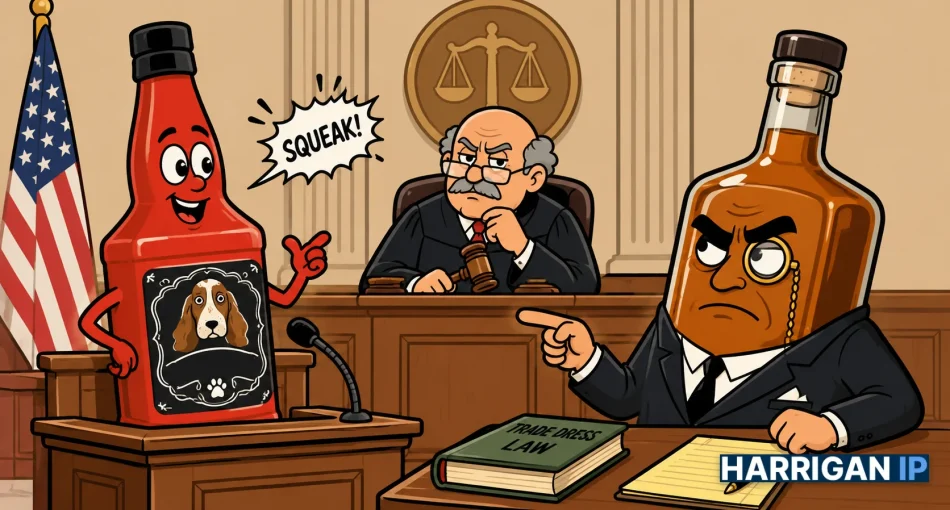
When Is a Joke Legal? Trademark Parody Lessons From the Bad Spaniels Dog Toy
By Brad Harrigan, Harrigan IP
A dog toy shaped like a whiskey bottle has now outlasted three presidential administrations in court, and the latest ruling swings back toward the joke. A federal appeals court reversed a win for Jack Daniel’s in its long-running fight with VIP Products over the “Bad Spaniels” squeaky toy, finding the parody did not harm the whiskey brand’s reputation. For anyone building a business on humor, this is worth understanding, because trademark parody is one of the trickiest corners of brand law.
The Bad Spaniels toy copies the shape and look of a famous whiskey bottle, then swaps the words for gags aimed at dogs. It replaces “Old No. 7” with “the Old No. 2, on your Tennessee Carpet,” and trades the alcohol content lines for “43% Poo By Vol.” and “100% Smelly.” You either laugh or you don’t, but either way the legal question is serious.
How a Squeaky Toy Reached the Supreme Court
VIP Products started this fight in 2014 by suing for a declaration that its toy did not violate Jack Daniel’s rights, after the whiskey maker sent a cease-and-desist letter. The case has bounced through the trial court and the Ninth Circuit more than once, and it reached the U.S. Supreme Court in 2023.
The Supreme Court’s ruling narrowed a defense that parody sellers had leaned on for years. When a company uses another brand’s trademark as its own source identifier — as a brand for its goods, not just as an expressive reference — it does not get the extra First Amendment cushion that expressive works usually enjoy. In plain terms, the Court said you can’t dress your commercial mark up as “art” to dodge the ordinary trademark analysis.
The First Amendment, for the non-lawyers, is the constitutional free-speech protection that sometimes shields expressive uses of a brand. The Supreme Court did not throw that protection out. It just said Bad Spaniels was using the whiskey trade dress to identify its own product, so the normal rules applied. The case then went back down for the trial court to run that analysis.
Two Different Claims: Infringement and Dilution
To follow the reversal, you have to separate two claims that often ride together but ask different questions.
Infringement asks whether consumers are likely to be confused about who made or sponsored the product. That is the heart of most trademark disputes. If shoppers think the whiskey company made or blessed the toy, that’s a problem.
Dilution is a separate, narrower doctrine reserved for famous marks. It protects the strongest brands even without consumer confusion. Dilution comes in two flavors: blurring, which weakens a famous mark’s distinctiveness by spreading it thin, and tarnishment, which links the famous brand to something unsavory. Jack Daniel’s tarnishment theory was that pairing a premium whiskey with dog excrement drags the brand’s image through the mud.
Why the Court Sided With the Dog Toy This Time
After the case returned, the trial judge found the toy diluted Jack Daniel’s marks by tarnishing them and issued a permanent order banning sales. On appeal, a three-judge panel reversed that ban unanimously, holding that Bad Spaniels would not harm the whiskey brand’s reputation.
The reasoning turned on context. The court pointed out that Bad Spaniels is a parodic dog toy not meant for human consumption, and reasoned that scatological jokes printed on a dog toy don’t carry the same likelihood of disgust as the same jokes printed on something people are supposed to drink. A poop joke on a squeaky toy reads as a poop joke. The same words on a bottle you’d pour into a glass hit differently.
That distinction matters for your marketing. Tarnishment isn’t automatic just because a parody is crude or a big brand feels insulted. A court looks at whether the specific use, in its actual context, realistically damages the famous brand’s reputation. A humorous product aimed at pets is a very different context than a knockoff aimed at the same consumers who buy the original.
What This Means If You Build a Brand on Humor
Here’s the honest read: this ruling is encouraging for parody sellers, but it is not a license to copy famous brands. Notice what VIP got and what it went through to get it. After twelve-plus years and a trip to the Supreme Court, the company won on the dilution-tarnishment piece. That is a long, expensive road for a squeaky toy.
The bigger lesson from the Supreme Court’s earlier ruling still stands. If you use a famous brand’s look as your own product’s branding, you don’t get a free pass. Your parody still has to clear the ordinary likelihood-of-confusion analysis, and “but it’s a joke” is not, by itself, a defense to consumer confusion. The strongest parodies make the joke obvious enough that no reasonable shopper thinks the original brand is behind it.
A few practical guardrails if humor is your angle. Make the parody unmistakable, so the gap between you and the target is the whole point. Pick a clearly different product category and audience where confusion is unlikely. Avoid anything that suggests sponsorship or endorsement. And build your own distinctive brand identity around the joke rather than riding entirely on someone else’s trademark.
Parody Is a Defense, Not a Shield From Getting Sued
Winning a parody argument and avoiding a lawsuit are two very different outcomes. VIP prevailed, eventually. It also spent over a decade in litigation to get there. A cease-and-desist letter can land in your inbox no matter how airtight you think your joke is, and responding takes time and money.
If you receive one, don’t panic and don’t fire back a snarky reply. Get a clear-eyed read on whether your use is likely to be seen as expressive parody or as a source identifier that competes with the brand you’re spoofing. That distinction, more than how funny you are, tends to drive the outcome. Our infringement and enforcement page walks through what a real threat looks like versus a bluff.
On the flip side, if you own a brand and someone is parodying it, the Bad Spaniels saga shows that context cuts both ways. A dilution claim against an obvious joke aimed at a different audience is a heavy lift. Before spending on litigation, it’s worth an honest assessment of whether a court will actually see harm to your reputation. Sometimes an agreement or a targeted response beats a twelve-year war over a dog toy.
The through-line here is that trademark parody lives in the gray zone between free expression and brand protection, and the winner is usually decided by the specifics: what you sell, who buys it, and whether anyone is genuinely confused. Get those facts right before you get clever.
Thinking about a brand with a wink in it, or worried someone is spoofing yours? Contact Harrigan IP for a flat-fee, straight-talking assessment. If you’re ready to protect the real brand behind the joke, our Comprehensive registration package includes a full clearance search so you know where you stand before you file, and our trademark monitoring service keeps watch for copycats. For more on where humor meets trademark law, see our piece on trademarking a viral phrase.
Get startedQuestions? Talk to Harrigan IP
Contct Us
Contact Us Today
"*" indicates required fields
Location
Harrigan IP
8117 Oak Street, Suite 203
New Orleans, LA 70118

Phone
© Copyright 2026 Harrigan IP. All rights reserved.