
Selling Your Business? Your Name Might Not Be Yours Anymore
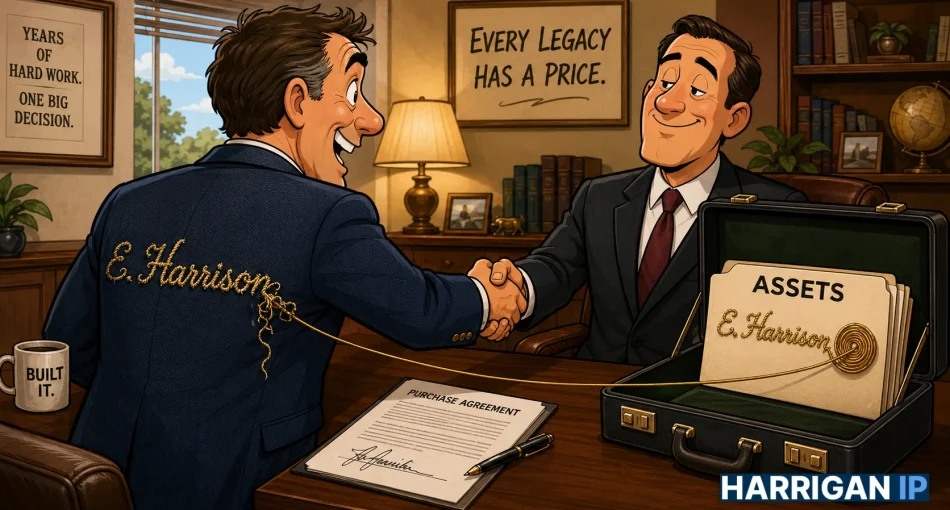
Selling Your Business? Your Name Might Not Be Yours Anymore
By Brad Harrigan, Harrigan IP
Here is a scenario that catches founders off guard more than almost anything else in branding. You build a company under your own name, you sell it, and you move on to your next thing. Then you try to put your name on a new product, and the people who bought your old company send you a legal threat.
The Financial Times recently ran a reader question that lays this out perfectly. A founder set up a company using their own name, sold it, and now wants to credit themselves as the creator of new products. Their former backers are threatening to sue. The reader’s question is the one I get all the time: can they really stop me from using my own name?
The uncomfortable answer is that they sometimes can. And the reason has everything to do with what happens to a trademark when you sell a business.
Your Name Stops Being “Yours” the Moment It Becomes a Trademark
A trademark is a word, name, or symbol that tells customers who is behind a product or service. The instant your personal name starts doing that job, the law treats it as a brand asset, not just a label on your birth certificate.
When you sell a company, the buyer is paying for the brand right along with the desks and the customer list. If your name was registered as a trademark by the business, that registration is part of the package they bought. They now own it. You don’t, even though it is still printed on your driver’s license.
This is why the difference between a word mark and a logo and the question of trademarking your own name matter so much before any deal closes. Once the ink dries, untangling it is far more expensive than getting it right up front.
There’s an “Own Name” Defense, But It Has Teeth Only So Far
The good news in the FT piece: the law generally lets you identify yourself truthfully as the creator of new work. You can credit yourself as the designer, the inventor, the author. Biographical notes and acknowledgments are usually fine. What the law will not allow, as the column put it, is the reconstruction of your personal brand by stealth.
That’s the line. Using your name descriptively, as a credit, tends to be acceptable. Using your name as a brand again is where you get into trouble.
The tell-tale signs that you’ve crossed over are practical and easy to spot. Putting your name on product packaging. Using it as the product name itself. Making it the header of your marketing. Grabbing it as a website domain or a social media handle. Giving it the kind of prominence that says “this is the brand” rather than “this is the person who happened to make it.”
Two Separate Problems: The Contract and the Trademark
This situation comes in two layers, and you have to deal with both.
The first is the contract you signed when you sold. Acquisition agreements routinely restrict what former owners can do for a set period after the sale. The buyer paid real money for that brand and wants to protect it, so these restrictions are normal and often broad. If your new activity breaches those terms, the buyer may be able to claim damages or get an injunction, which is a court order forcing you to stop. Before you do anything, read that contract carefully with a lawyer.
The second layer is trademark law itself. If your name is a registered mark owned by the company you sold, using it to promote new products could be infringement, full stop. The “own name” defense exists, but it only protects honest, descriptive use, not a quiet relaunch of your old brand under a new banner.
Even Without a Registration, “Passing Off” Can Bite
Say the buyer never registered your name as a formal trademark. You’re still not in the clear. If they’ve built up, or acquired from you, goodwill and reputation in your name, using it in a way that suggests endorsement or a connection to your old company can amount to passing off.
Here’s the part founders miss: what matters is not your intention. It’s how consumers perceive your use. If customers see your name on a new product and assume your former company is behind it, you have a problem, no matter how innocent your motives. That’s the same consumer-confusion logic that drives most trademark disputes.
This Isn’t Theoretical
The FT points to ongoing litigation involving Jo Malone, who sold her fragrance business to Estée Lauder and later collaborated with Zara under the brand “Jo Loves.” The reporting frames it as an example of how fiercely buyers will defend a personal name once they’ve acquired it as a trademark, and how carefully founders have to navigate the boundary between their identity and someone else’s brand asset. (As with any pending matter, the outcome is for the court to decide.)
If a name as established as Jo Malone’s can become a battleground, a smaller founder-led brand absolutely can too. The pattern is the same every time: the founder assumes the name is theirs forever, and the buyer assumes they paid for it.
What This Means for Your Business
If you ever plan to sell, or even might, treat your name like the asset it is, not like a given. Decide early what you’re selling and what you’re keeping. Sometimes the smart move is a carve-out or a license that lets you keep using your name in defined ways after the deal. Sometimes it’s a coexistence arrangement spelling out exactly who can use the name where.
The worst time to figure this out is after you’ve signed and cashed the check. Plan for it while you still hold the leverage, which is before the deal closes.
If you’re building a brand around your own name, or thinking about selling one, talk to us before you commit. Harrigan IP is a flat-fee trademark firm, so you’ll know the cost up front. Get in touch here, lock in your rights with our Comprehensive registration package, and if a buyer or competitor is already using your name, our trademark monitoring service can flag it before it becomes a lawsuit.
Contct Us
Contact Us Today
"*" indicates required fields
Location
Harrigan IP
8117 Oak Street, Suite 203
New Orleans, LA 70118

Phone
© Copyright 2026 Harrigan IP. All rights reserved.