
Lionel Richie Wants to Trademark His Voice to Fight AI Clones
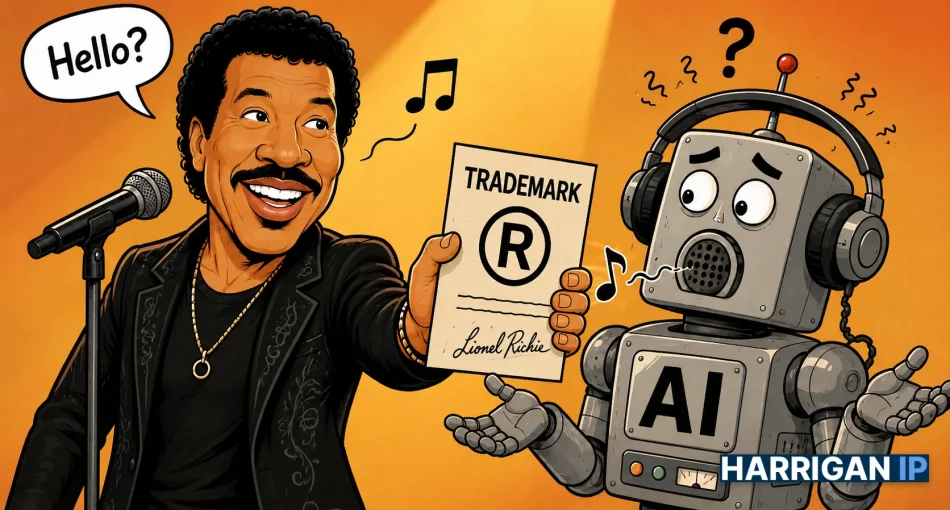
Hello, Is It a Trademark You’re Looking For? Lionel Richie Tries to Trademark His Voice
By Brad Harrigan, Harrigan IP
Lionel Richie reportedly filed four applications at the U.S. Patent and Trademark Office to trademark a voice — specifically, recordings of him singing the choruses to hits like “Hello,” “Say You, Say Me,” “Easy,” and “All Night Long (All Night).” Yes, that includes “Hello, is it me you’re looking for?” The goal, according to reporting on the filings, is to build a legal shield against AI tools that clone an artist’s voice.
He’s not alone. Reports indicate Taylor Swift has applied to register her voice saying “Hey, it’s Taylor,” and Matthew McConaughey sought protection for “Alright, alright, alright.” When that many famous people start filing the same unusual paperwork at the same time, something real is happening underneath. So let’s talk about whether you can actually trademark a voice — and what that does and doesn’t get you.
Can You Trademark a Voice? Sound Marks Are Real
A trademark is anything that identifies the source of a product or service in the minds of consumers. Most are words or logos. But a trademark can also be a sound — these are called sound marks, and they’re a recognized category. The NBC chimes and the Netflix “tuh-dum” are the classic examples.
So a voice, in theory, can be registered the same way any sound can. There’s nothing in the rulebook that says “voices don’t count.” If you’re new to the whole concept, our explainer on what a trademark actually is is a good starting point, and our piece on word marks versus logos covers how different formats get protected.
The catch is that a sound mark has to do the one job every trademark has to do: tell consumers where a product comes from. That’s a much heavier lift for a singing voice than it is for a five-note jingle a company plays on every ad.
Why “Trademark a Voice” Is an Uphill Climb at the USPTO
Here’s the hurdle. To win a federal registration, you have to prove that consumers associate the thing you’re claiming with particular goods or services as a source identifier — not just that it’s famous. Fame and trademark function are two different things.
A snippet of a hit song lyric is famous because it’s a great song. That’s not the same as the public hearing that snippet and thinking “this identifies the source of [specific goods].” The Trademark Office is going to want evidence that the sound works as a brand, not just as a beloved chorus. As one of the attorneys involved put it in reporting on the filings, the USPTO “will expect evidence that the sounds function as trademarks rather than simply famous lyrics.”
That’s the central tension. A familiar phrase being instantly recognizable does not automatically make it registrable. We’ve written before about exactly this problem in our piece on whether you can trademark a viral phrase — recognition and trademark function are not the same animal. Expect these voice applications to draw refusals on that ground, which means responding through the office action process with real evidence.
Even If It Registers, a Sound Mark Is Narrow
Say one of these applications makes it through. The protection you’d get is narrower than people assume.
A trademark covers a specific mark for specific goods or services. So a registration for a voice singing one particular lyric protects that — the voice, that lyric, those goods. It is far from certain that such a registration would let the owner stop someone from using a similar-sounding voice singing different words. Trademark law protects brand source identifiers; it does not hand anyone blanket ownership of their entire identity or every sound they could possibly make.
That’s a key point for any business owner thinking strategically: a trademark is a precise tool, not a force field. It’s strongest when it covers a defined mark tied to real commercial use. Choosing what to file and how to describe it matters enormously, which is why we harp on choosing a strong trademark and on getting your goods and classes right from the start.
Why Not Just Use Publicity Rights?
If you’re wondering why a singer would reach for trademark law to protect his voice, here’s the answer: the more natural tool is weaker than you’d hope.
A person’s name, likeness, and voice have traditionally been guarded by what’s called the right of publicity — the right to control commercial use of your identity. The problem is that publicity rights are a patchwork of state laws. They vary from state to state, and historically they’ve often applied only to unauthorized advertisements and endorsements. There is no single nationwide statute that cleanly covers AI voice cloning.
So artists are reaching for trademark law not because it fits perfectly, but because it’s federal, it’s national, and it’s something rather than nothing. It’s a workaround for a gap Congress hasn’t filled. A proposed federal NO FAKES Act has been floated to create stronger national protection against unauthorized digital replicas, but it has not become law. Until something like it passes, expect more of these creative filings.
What AI Cloning Means for the Rest of Us
This isn’t only a celebrity problem. AI tools that can mimic a voice or generate a fake video are now cheap and widespread, and the same technology that can clone a pop star can clone a local business owner who narrates her own ads, a coach with a recognizable catchphrase, or a brand built around one person’s distinctive delivery.
If your business is your voice or your face — a personal brand, a course creator, a spokesperson-led company — the lesson here is to lock down what you actually can. Register your business name and logo. Register your slogan if it functions as a brand. Those bread-and-butter registrations are the foundation everything else stands on, and if you’re building around your own name, our guide on trademarking your name walks through it.
And keep watch. Even the best registration does nothing sitting in a drawer — enforcement is what gives it teeth. If a knockoff or an AI-generated imitation shows up, you’ll want to know early, which is the whole point of trademark monitoring, and you’ll want a plan for enforcing your rights once you spot a problem.
The Honest Bottom Line
The smart read on Richie’s filings is that they’re early moves in a much bigger shift, not a settled solution. Whether the registrations succeed is an open question, and even a win would be narrower than the headlines suggest. What’s really being established here is provenance — proof that a voice came from a specific person who authorized its use — and the law hasn’t fully caught up to that idea yet.
For your business, the takeaway is steadier and less glamorous: build the protectable assets you can actually register, use them in commerce, and watch for misuse. That’s a strategy that works today, not one waiting on a law that may never pass. You can see how we think about the full toolkit on our practice areas page.
Worried your brand — your name, your voice, your logo — isn’t locked down? Let’s fix that. Contact Harrigan IP to talk it through, or get moving with our flat-fee Comprehensive trademark package. And if you want eyes on the marketplace so copycats don’t catch you off guard, ask about trademark monitoring.
Get startedQuestions? Talk to Harrigan IP
Contct Us
Contact Us Today
"*" indicates required fields
Location
Harrigan IP
8117 Oak Street, Suite 203
New Orleans, LA 70118

Phone
© Copyright 2026 Harrigan IP. All rights reserved.