
Can You Trademark Your Social Media Handle? A Small Business Guide
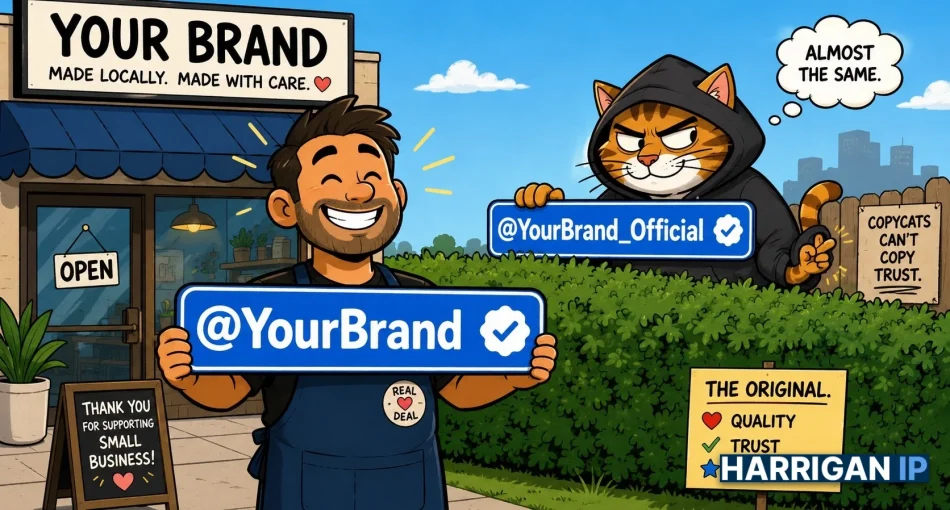
Can You Trademark Your Social Media Handle? A Small Business Guide
By Brad Harrigan, Harrigan IP
Your social media handle is doing a lot of work. It’s the name customers tag in their posts, the one they search for, and often the first version of your brand a new customer ever sees. So it’s fair to ask: can you actually trademark your social media handle—or is it just a username that anyone could swipe out from under you?
The short answer is yes, you can. But there’s an important catch that trips up a lot of small business owners, and it has nothing to do with the social platform. It has to do with how trademark law actually works.
What a Trademark Protects (and What It Doesn’t)
A trademark is a word, phrase, logo, or other identifier that tells customers where a product or service comes from. The whole point of trademark law is to prevent consumer confusion—the situation where shoppers can’t tell your brand apart from someone else’s. If you want a deeper primer, we wrote a full explainer on what a trademark is.
Here’s the part that matters for handles. The U.S. Patent and Trademark Office (USPTO) doesn’t register a name simply because you typed it into a profile box. It registers a name because you’re using it as a brand—to sell goods or provide services to the public. That distinction is everything.
So “@yourbrand” isn’t protectable just because you claimed it on Instagram. It becomes protectable when it functions as a source identifier for your business—when customers see that name and connect it to the products or services you actually sell.
When a Handle Is Registrable—and When It Isn’t
The good news: the USPTO allows just about anything that distinguishes a brand to be registered, from names and logos to slogans, and even colors and scents. Your handle can absolutely qualify if it does real branding work.
But two things commonly stand in the way. First, the “@” symbol and the platform name (like “Instagram” or “TikTok”) usually don’t help you. The USPTO tends to treat those as informational—they tell people where to find you, not who you are. The part that earns protection is the distinctive brand name inside the handle.
Second, the name itself has to be strong enough to register. If your handle is generic or merely describes what you sell, the USPTO will refuse it. “@bestcoffeeshop” is going to have a hard time. A coined or arbitrary name has a much easier path. This is exactly why choosing a strong trademark matters before you ever fall in love with a username.
You’re Registering the Brand, Not the Username
One mental shift helps here. You’re not really registering “your handle” as a string of characters. You’re registering the brand name that lives inside it, in connection with specific goods or services.
Trademark applications are organized into international classes based on what you sell. A clothing line files in a different class than a software company or a consulting service. Your registration covers your name for those goods and services—which is what actually lets you stop a competitor from using a confusingly similar name in your space.
That’s a stronger and more flexible right than “I own this username on one app.” Platform usernames are governed by each platform’s own rules, and those rules can change. A federal trademark registration is a legal asset you own that doesn’t disappear when an app updates its policy.
Before You File, Search
Before you spend money registering anything, you need to know whether someone is already using a confusingly similar name. This is the step most people skip and later regret.
A proper clearance search looks at registered trademarks and real-world use to flag conflicts before you’ve built your whole brand around a name you can’t protect—or worse, a name that’s already infringing someone else’s rights. We break down the why and how in this guide to searching before you file.
Find a conflict and you’ve saved yourself a refusal, a rebrand, or a nasty cease-and-desist letter. Find a clear path and you can file with confidence. Either way, you want this answer up front, not after you’ve printed the merch.
Why Registering Is Worth It
A registered trademark for your brand name does three concrete things for an online business. It gives you nationwide legal ownership of the name in connection with your goods or services. It puts the world on notice that the name is taken. And it gives you real leverage when someone copies you.
It also turns your name into an asset you can sell or license. Because you own the registered mark, a brand that wants to use it has to come to you. For influencers and product brands whose identity is the name, that’s not a minor detail—it’s the business.
And if you ever need to act, having a registration on file changes the conversation. Platform takedowns, demand letters, and enforcement actions all go better when you can point to a federal registration instead of arguing about who used a username first.
Registration Alone Isn’t Enough—You Have to Watch
Here’s the trap. People register a trademark, file it in a drawer, and assume they’re protected forever. Trademark rights don’t enforce themselves. If a copycat starts using your brand name online and you do nothing, you can actually weaken your own rights over time.
That’s where trademark monitoring comes in. Monitoring means keeping an eye on new filings and uses that conflict with your brand, so you catch problems early—while they’re still cheap to fix. We explain how it works in this overview of trademark monitoring services.
There’s a free-speech wrinkle worth knowing, too. Genuine fan accounts and clear parody handles often get protection, because they aren’t trying to fool anyone into thinking they’re you. The line moves when someone uses your name to sell competing products, impersonate your brand, or divert your customers. That’s the kind of confusion trademark law was built to stop, and the kind we cover in what to do if someone infringes your trademark.
What This Means for Your Business
Your handle is part of your brand’s identity, and protecting it is a mix of three things: registering the right name, watching how your brand shows up online, and being ready to act when someone crosses the line.
The earlier you do this, the cheaper and easier it is. Secure your name before a competitor does, file it in the classes that match what you sell, and keep an eye on the field. In a marketplace where your name is often a customer’s first impression, owning it beats fighting for it.
If you’re launching a brand, picking a name, or worried someone’s already using yours online, let’s talk. You can contact Harrigan IP to get started, or jump straight to our flat-fee trademark registration—the Comprehensive package bundles a clearance search so you know your name is clear before you file. And if you’re more worried about copycats than filing, our trademark monitoring service watches your brand so you don’t have to.
Get startedQuestions? Talk to Harrigan IP
Contct Us
Contact Us Today
"*" indicates required fields
Location
Harrigan IP
8117 Oak Street, Suite 203
New Orleans, LA 70118

Phone
© Copyright 2026 Harrigan IP. All rights reserved.