
Starbucks Is Suing Its Own Union Over Trademark Use
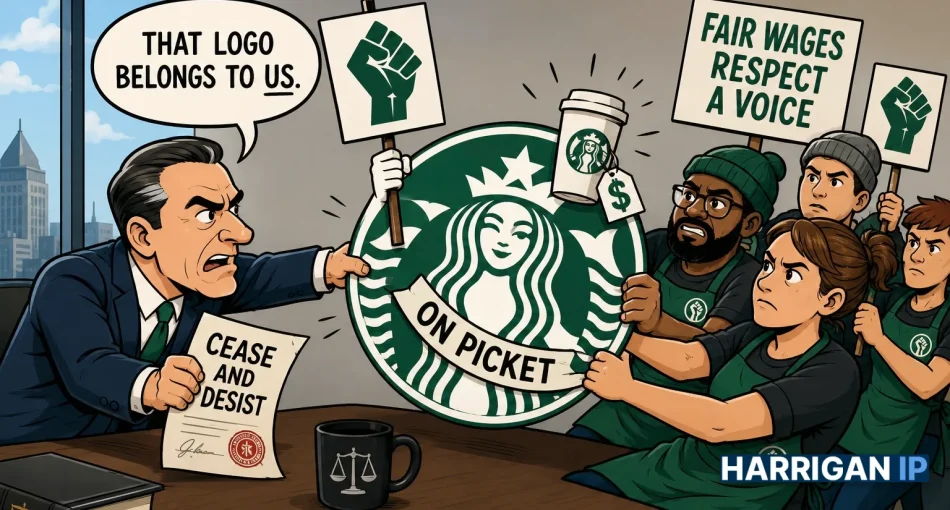
Starbucks Is Suing Its Own Union Over Trademark Use
By Brad Harrigan, Harrigan IP
Most trademark fights pit a brand against an outside copycat. This one is stranger. Starbucks has filed suit in Iowa federal court claiming that its own union—Starbucks Workers United—is infringing and diluting the company’s trademarks by using the Starbucks name and a green circular logo that echoes the famous “siren” mark.
According to the complaint filed in the U.S. District Court for the Southern District of Iowa, the union has used the Starbucks name and a similar circular green logo on its websites, apparel, and coffee mugs sold online. Starbucks says that crosses a line from protected union activity into commercial use of a famous brand. It’s a vivid lesson in who actually gets to use your trademark—and where the limits sit.
What Starbucks Is Actually Claiming
A trademark is a word, logo, or symbol that tells the public who stands behind a product or service. Starbucks owns federal registrations for its name and its green siren logo, and registration is what gives a brand the legal muscle to stop unauthorized use.
The lawsuit leans on two ideas. First, ordinary infringement: using a confusingly similar mark in commerce in a way that misleads consumers about source or sponsorship. Second, dilution—a doctrine reserved for famous marks that lets the owner stop uses that blur or tarnish the brand even without consumer confusion. Starbucks plainly qualifies as a famous mark, which is exactly why dilution is on the table here.
In the complaint, Starbucks says “no other company, organization, or person, including defendants, should trade on Starbucks goodwill, or dilute the Starbucks brand, by selling merchandise that uses the Starbucks name or close variants of its logos.” The company also objects to its name and logo being used “to wrongly suggest that Starbucks made, sponsored or endorsed statements on social, political or geopolitical issues.”
The Union’s Side—and the Free Speech Question
Here’s the wrinkle that makes this case interesting. Starbucks itself concedes that labor unions have the right to organize, to use an employer’s name for protected union activities, and to speak their minds. Its argument is narrower: that right is not, in the company’s words, “a free pass to use, dilute, and damage a famous brand for any purpose, such as merchandise sales and statements on social, political, and geopolitical issues having nothing to do with protected union activities.”
So the line Starbucks is drawing is between referring to an employer to organize its workers—generally allowed—and selling branded merchandise or making political statements that ride on the company’s logo. That distinction tracks a real principle in trademark law called nominative fair use, which lets you name a brand when there’s no other practical way to refer to it, so long as you don’t suggest the brand sponsors or endorses you.
The union sees it differently. It says it is “simply seeking a declaration that it may continue to use the name and logo that have been core to organizing the 12,000-member union of Starbucks baristas for the past five years.” These are allegations on both sides; a court will decide where reference ends and infringement begins.
Two Courts, One Fight
This dispute is now running in two places. Starbucks says it tried to negotiate a settlement of its trademark claims, but the union instead filed suit in April in Pennsylvania federal court seeking a declaratory judgment—a court ruling that it may keep using the name and logo. Starbucks then filed its own infringement and dilution complaint in Iowa.
That sequence is a classic litigation maneuver. When a party fears it’s about to be sued, it sometimes files first in a friendly forum and asks the court to declare its conduct lawful. The trademark owner counters by filing its own suit somewhere else. The two cases will likely get sorted out procedurally before the substance gets decided.
The Starbucks complaint was filed by lawyers at Nyemaster Goode in Des Moines with assistance from Sullivan & Cromwell, and names Starbucks Workers United, the Chicago and Midwest Regional Joint Board, and Iowa City Starbucks Workers United as defendants. The union, for its part, frames the trademark cases as a sideshow to a stalled contract fight, pointing to more than 560 outstanding unfair labor practice charges it wants resolved.
The Lesson: Control Who Uses Your Brand
Strip away the labor politics and the Starbucks trademark lawsuit makes a point that applies to any brand owner. Your mark is only as strong as your willingness and ability to police it—and policing starts with registration. Starbucks can make these claims at all because it holds federal registrations for the name and the siren. Without them, a lot of this argument falls apart.
Two practical takeaways. First, register your core marks—both the word mark and the logo, since they protect different things. If you’re weighing which to file, our breakdown of word mark vs. logo walks through the trade-offs.
Second, decide in advance who can use your brand and how. Employees, partners, affiliates, fan accounts, and yes, even an organized workforce can all end up putting your name on things. Clear written guidelines and a willingness to enforce them keep “helpful” uses from quietly becoming uses you can’t control. When you do spot a problem, options range from a polite letter to a full infringement and enforcement action.
Catching the unauthorized use is half the battle. Most brand owners never see the mug, the t-shirt, or the lookalike logo until a customer points it out. A trademark monitoring service exists to surface those uses early, while your options are still cheap and quiet. You can read the underlying report on this case at Courthouse News.
Whether Starbucks wins on dilution or the union prevails on fair use, the dispute confirms the same thing every brand owner should internalize: famous or not, you only get to draw lines around your name if you secured it first.
Worried about who’s using your brand? Get in touch with Harrigan IP for a flat-fee answer. If you haven’t locked down your name and logo yet, start with our trademark registration service, and consider adding ongoing monitoring so you find the knockoffs before your customers do. Want the bigger picture first? Here’s what happens if someone infringes your trademark.
Get startedQuestions? Talk to Harrigan IP
Contct Us
Contact Us Today
"*" indicates required fields
Location
Harrigan IP
8117 Oak Street, Suite 203
New Orleans, LA 70118

Phone
© Copyright 2026 Harrigan IP. All rights reserved.